 |
Munch: The Portraits
| By Roderick Conway Morris |
LONDON 22 May 2025 |
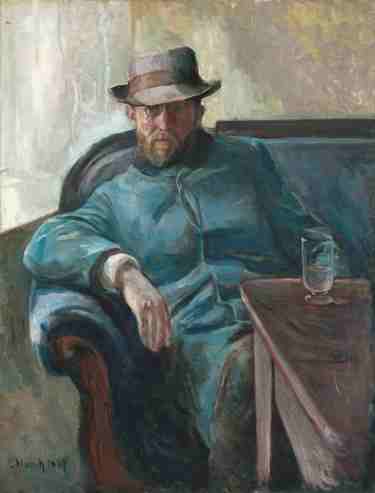 |
Nasjonalmuseet, Oslo Hans Jaeger by Edvard Munch, 1889 |
'A painter like Munch is rooted in the psychological with all his fibres,' wrote the German critic Franz Servaes in the 1890s. 'He cannot even depict a landscape without making its soul his own. For the same reasons, he is also a highly sensitive portrait painter.'
Edvard Munch (1863–1944) made portraits throughout his long career, right up until he laid down his brushes for the last time just before his death at the age of 81 in 1944. He created around 400 of them, including drawings, etchings and lithographs. Yet this aspect of his work has received the least attention. An engaging and revealing exhibition, 'Edvard Munch: The Portraits', curated by Alison Smith with Knut Ljøgodt at the newly re-opened National Portrait Gallery, now unfolds the central role that this genre played in his oeuvre.
Munch was born in 1863 into a family that had already made notable contributions to Norwegian art and culture. His father's forebears included churchmen and intellectuals and a neo-classical painter, Jacob Munch, who was a co-founder of the Royal Drawing School in 1819. An uncle, Peter Andreas Munch, was the author of the 'History of the Norwegian People' (1852–63), which was influential in the movement for independence from Swedish rule (finally achieved in 1905). His mother's family were farmers and sea-captains with artistic tastes, and it was to this side of his lineage that Munch attributed his own talents.
Edvard's father, Christian, had been a ship's doctor, who now made a modest living as a doctor in a poor district of the country's capital, Christiania (which became Kristiania in 1877, and reverted to its medieval name Oslo in 1925). The family was devastated in 1868 when Edvard's mother died of tuberculosis. His adored sister Sophie succumbed to the same disease at 15 in 1877, and his brother, Andreas, who had qualified as a doctor, died at 30 of pneumonia. His sister Laura, while still young, began to manifest symptoms of mental illness.
The artist later gloomily recalled: 'Sickness, insanity and death were the black angels that guarded my cradle and have since followed me throughout my life.'
Like many other aspiring artists Munch's first portraits were of himself and his family. On a seaside holiday in 1888, a welcome break from the cramped accommodation the family rented in Kristiania, Edvard's sisters remembered being continually summoned to sit for him. After his wife's death, Munch's father became increasingly melancholy and religiously obsessed. But matters were greatly improved by his wife's younger sister, Karen, moving in with them. This 'marvellous aunt', as Munch described her, was herself artistically gifted and persuaded Edvard's father to let him pursue a career as a painter.
Kristiania's population numbered a mere 135,000 in 1885. It was deeply conservative, provincial and inward-looking. Munch dubbed it 'that Siberian town', but during this period the scene was enlivened by the presence of a small group of artists, writers and intellectuals who had experienced Bohemian life abroad, especially in Paris.
The young Munch found himself welcomed into this coterie, who advocated free love and radical politics and were ostracized by their respectable fellow citizens, and they provided him with exciting new subjects for portraiture. Prominent among these social rebels was the anarchist Hans Jaeger, whom he painted in 1889 slumped at a café table just after his release from prison. Jaeger had published a scandalous autobiographical novel, 'From the Kristiania Bohème', which was banned and its author incarcerated. Munch had provided Jaeger with an erotic drawing of a woman naked to the waist as company in his prison cell.
When Munch exhibited his first of many full-length portraits, a suitably risqué rendering of Karl Jensen-Hjell, famed for his rackety, hedonistic life-style, at the Autumn Exhibition in Kristiania in1885, it was roundly condemned by a critic as 'a travesty of art' and 'just daubed straight onto the canvas'.
With limited art education available in Norway, aspiring artists were more or less obliged to expand their horizons by going abroad. Despite the hostile reception to some of his work, Munch was awarded a grant to spend three winters studying in Paris between 1889 and 1891. In 1892 he received an invitation to exhibit in Berlin and went on to spend over a decade abroad, punctuated by summer visits to Norway. His first solo exhibition in Germany's capital, of 55 Symbolist works, including 'The Sick Child' and 'Melancholy', was a succès de scandale. It was attacked by most critics, one of whom dismissed the pictures as having 'absolutely nothing to do with art'. The show closed after a week, but Munch's international reputation as a bold young avant-garde artist was made, and the exhibition went on to Düsseldorf and Cologne. The event even contributed to the founding of the breakaway art group that became the Berlin Secession.
Munch's elevated profile opened up a new clientèle for his portraits. In the first part of his career, the artist mainly did portraits of subjects of his choice, but later increasingly on commission. It was his practice to paint two versions, letting his sitter choose one and keeping the other for himself. His preparation was also idiosyncratic. As his patron and promoter Dr Max Linde recorded: 'Munch can go for weeks without putting brush to canvas… Then it is only a matter of days, even hours, before his pictures are ready.' He did far fewer portraits of women than men, but they are among his most striking.
His relationships with women in general were conflicted. As he once declared, 'I have always put my art before everything else. Often I felt that women would stand in the way of my art.' Munch met the English violinist Eva Mudocci (whose real name was Evangeline Hope Muddock) in Paris in 1903 and fell in love with her (although she was reputed to be 'intimate' with her piano accompanist, Bella Edwards).
Having ditched earlier attempts, he did Mudocci's lithograph portrait directly onto a stone propped on an easel. This extraordinary image, entitled 'The Brooch. Eva Mudocci', is strongly reminiscent of those of Pre-Raphaelite beauties. But she was upset by a subsequent lithograph of her as a femme fatale in 'Salome', where she appeared in a typical Munchian mode alongside his own seemingly detached head. 'It was that title that caused our only row,' she later recalled. Their relationship lasted several years.
Sitting for Munch could be an alarming experience. While painting the banker and collector Ernst Thiel in 1907 the artist, dissatisfied with the canvas, 'suddenly put his fist straight through it, and sent the easel dancing across the floor'. When his fellow-artist Ludvig Karsten came to Munch's seaside home to pose for a full-length portrait in a dandyish white suit and wide-brimmed hat, during the sitting Munch shot the cigarette out of his mouth with a pistol in order to unnerve him.
Many of Munch's patrons and collectors in Germany were cultured Jewish professionals and entrepreneurs, prospering after the emancipation of the Jews in the German states in 1871. A prominent example was Walther Rathenau, son of the founder of the mighty engineering company AEG, who had known the artist from his first days in Berlin. Munch painted a now celebrated portrait of Rathenau in 1907. Its subject sardonically commented of the portrayal: 'An awful character, isn't he? That's what you get for having your portrait done by a great artist – you look more like yourself than you really are.' After the First World War, Rathenau was made Foreign Minister in the Weimar Republic, but was assassinated by anti-semitic nationalists in 1922. Many other such patrons were to suffer with the rise of Hitler.
Constant travelling between Paris, German cities, Norway and Sweden for exhibitions and commissions, together with overwork and excessive drinking, led to a mental breakdown in 1908 and Munch's admission to a psychiatric unit in Copenhagen. In 1909, he returned to Norway, where he was to spend most of the rest of his life. He disliked the psychiatrist at the Danish clinic, Dr Daniel Jacobson, depicting this goatee-bearded Mephistophelean figure against a background of what the artist described as 'a fire with all the colours of hell'.
The recipient's response suggested that his treatment of the patient had not been entirely successful: 'Just look at the picture he painted of me, it's stark raving mad.'
The artist's closest associates were often the most dissatisfied of his sitters. His good friend the critic Jappe Nilssen, who hailed Munch as 'the greatest painter that has ever lived in Norway', was severely disappointed with his portrait, saying: 'He has given full rein to his vicious side and could have painted a more beautiful portrait.' But the artist was philosophical, observing: 'When I paint a person his enemies always find the portrait a good likeness. He himself believes, however, that all the other portraits are a good likeness except the one of himself.'
Edvard Munch Portraits: Painting the human condition, National Portrait Gallery, London, 13 March–15 June 2025
'Edvard Munch: The Portraits' by Alison Smith with Knut Ljøgodt, NPG, pp 176 £35
A fully illustrated version of this article can be found at:
https://britishartjournal.co.uk/edvard-munch-portraits/
First published: British Art Journal: Online
© Roderick Conway Morris 1975-2026