 |
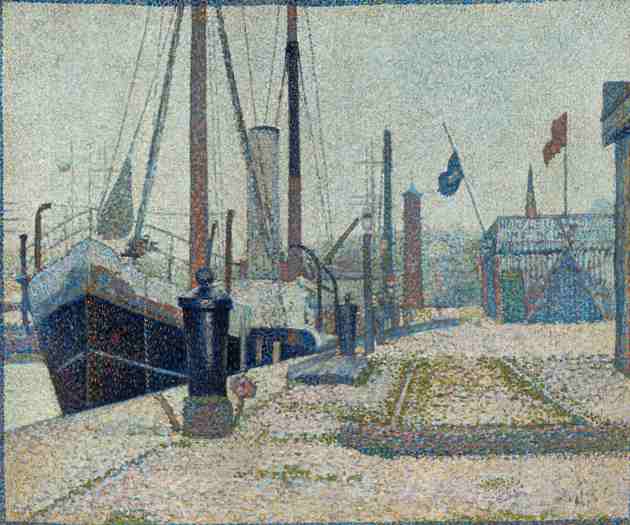 |
National Gallery, Prague The 'Maria' (Honfleur), 1886, reworked c. 1888–89, by Georges Seurat, 1886 |
Seurat and the Sea
| By Roderick Conway Morris | LONDON 21 May 2026 |
While at the École des Beaux-Arts in Paris, Georges Seurat (1859–1891) visited the Fourth Impressionist Exhibition in April 1879, which caused him 'an unexpected and profound shock' and inspired him to abandon his academic training and set up an atelier with two fellow students. He was called up for a year's military service in November of that year. Having been posted to Brest, according to the artist's first biographer Gustave Coquiot (1865–1926) he 'developed a liking for the sea and for boats of all sizes' and 'would draw in numerous notebooks, taking great care in depicting boat riggings, docks, smokestacks, anchors, masts, and moorings'. Meanwhile, he spent his time on leave exploring the length of the Channel coast of Brittany and Normandy.
The notebooks are now lost, but that year turned out to be an influential one in his short but productive life. After returning to Paris, Seurat began to elaborate a highly original method of painting, later known as Pointillism. Having had a drawing accepted by the Salon in 1883, his proto-Pointillist painting 'A Bathing Place, Asnières' (National Gallery, London) was rejected by the Salon but shown at the inaugural Salon des Indépendants in the summer of 1884. There were no juries or prizes, contributors could display up to 10 works and Seurat exhibited there every year until his premature death in 1891.
From 1885 onwards the artist established a routine of remaining in Paris during the winter, where he worked on large figural pieces, while spending several weeks every summer in a different location on the north coast, painting ports and seascapes. Of the nearly 40 major works of his final oeuvre, 24 – over half the total – were of harbours and seascapes. And yet the Courtauld's enthralling new exhibition 'Seurat and the Sea', curated by Karen Serres, is the first ever devoted to his marine pictures. Seventeen widely scattered canvases are on display, along with oil sketches and drawings, from public and private collections in the United States, Britain, the Netherlands, France, Germany, Czechoslovakia and Australia, while all the remaining sea pictures are also illustrated in the attractive and informative catalogue.
Seurat was from a comfortable bourgeois background and not reliant on his art to make a living, which was probably just as well, given the laborious nature of the pointillist method. His dedication to his calling was witnessed by his friend, the poet and art critic Gustave Khan (1859–1936), who wrote that in his 'small, narrow studio, inconvenient, freezing in winter and sweltering in summer, Seurat sat daily in front of his three-month canvas; he emerged emaciated and, to rest, went to paint seascapes.'
The artist gave away a number of canvases, but only sold three during his lifetime, being more concerned with recognition of his revolutionary technique and his talent than with sales. Also, it is important to note that he conceived his marine pictures in each location as being part of a series ideally to be displayed not only together but even in a certain order. Accordingly, the current show offers some exceptional opportunities fully to appreciate some of these sets of pictures: the six canvases of the Port-en-Bessin series (1888) are brought together here for the first time since they were displayed at the annual show of Les XX in Brussels in 1889; and the four of the Gravelines sequence, for the first time since the exhibitions of Les XX in Brussels and the Salon des Indépendants in Paris in 1891.
By the late 19th century an extensive railway network had made the Channel Coast easily accessible from the capital and resorts of varying fashionability were attracting increasing numbers of visitors. Large sums were also spent on improving fishing and commercial port facilities. The development of the coast and the artists, both native and foreign, who painted its ports, beaches, cliffs and seascapes are the subject of an invaluable and well-illustrated essay by Richard Thomson in the catalogue.
While Impressionism sought to catch the fleeting moment, Félix Fénéon, the coiner of the term Neo-Impressionism and early champion of the movement, wrote: 'To synthesize the landscape into a definitive form that perpetuates its sensation, such is the aim of the Neo-Impressionists.' By the same token while en plein air painting was de rigueur for the Impressionists, the meticulous methods of the likes of Seurat made it impracticable. Nonetheless, Seurat made preparatory oil sketches, or croquets, outdoors using a boîte à pouce, a portable painting box containing a small palette and tubes of colour held underneath with the thumb. He had a particular affection for these on-the-spot productions, once describing them to Charles Angrand (1854–1926) as 'my greatest joy'. Some of these croquets, such as 'Beach at Gravelines' (1890) on show here even came to be regarded by the artist as finished works in their own right.
Unlike artists such as Gauguin, who travelled to Pont-Aven in Brittany in search of the traditional and the folkloric, Seurat eschewed the picturesque and chose locations in Normandy that had undergone recent modernization. Less than a week after the closure of the Eighth (and last) Impressionist Exhibition in 1886, where he had exhibited seven canvases, including 'Sunday Afternoon on the Island of La Grande Jatte' (1884–86), he arrived at Honfleur.
Honfleur was a busy workaday port that had been substantially modernized over the previous decades and doubled its commercial traffic between 1874 and 1884. Seurat passed over its historic centre and concentrated on the docks and cliffs along the surrounding coast. This was his most productive summer campaign of all, producing seven canvases, four oil sketches and two conté crayon drawings. He gave Félix Fénéon 'Entrance to the Port of Honfleur' (1886) and sold the Belgian artist and writer Émile Verhaeren (1855–1916) 'The Hospice and the Lighthouse of Honfleur' (1886). He told the latter that the picture had taken two-anda-half months to complete, whereas 'Corner of a Harbour (Honfleur)' (Kröller-Müller Museum, Otterlo), had taken a mere eight days.
Having spent the summer of 1887 in Paris, he went to Port-en-Bessin the following year, very likely on the recommendation of his principal disciple Paul Signac (1863–1935), who had spent the three summers of 1882–1884 there. Although a smaller port than Honfleur, there had been major state investments in its infrastructure. In 1880, a 75-metre-long channel had been completed leading to an inner basin and steel swivel bridge, and a second basin was added shortly afterwards. The town had also acquired a new steel-framed fish market, fountain and dockside oil lamp post.
All these innovations were given prominence in Seurat's half-dozen canvases, which recorded the locale almost systematically, from the inner to the outer harbours, to views of the surrounding cliffs looking east and west.
An abiding feature of Seurat's marines was his close observation of signal masts with their balls and flags indicating whether tides were high, low, ebbing or flowing, always carefully recorded in his paintings. In his 'Seascape at Port-en-Bessin, Normandy' (1888) he did not neglect to include the cliff-top semaphore mast at the top-left of the picture, another important modern coastal facility for conveying vital information to mariners.
The next summer of 1889 produced the smallest crop of works of any of his sojourns on the Normandy coast. That year he moved northwards to Le Crotoy on the estuary of the Somme, which offered a more minimalist landscape of sand dunes and a handful of houses on the shore beneath billowing clouds. While unconcerned with selling pictures Seurat was intensely focused on having sufficient works ready for the forthcoming annual exhibitions and this might go some way to explaining why he felt free to devote himself to this pair of minutely realized works. The Salon des Indépendants had rented a smaller space that year, limiting artists to three works each, and he displayed only these two new canvases, 'Le Crotoy (Downstream)' and 'Le Crotoy (Upstream)', along with 'Port-en-Bessin – The Bridge and the Quays'.
In 1890 the artist moved yet further north to Gravelines described by the 1894 Baedecker as 'an uninteresting town with 5952 inhab', between Calais and Dunkerque, in the flatlands near the Belgian border, which nonetheless gave rise to 4 canvases, 4 croquets and 8 conté crayon drawings. He ignored the 17th-century inland town and its star-shaped fortifications and concentrated on the canalized River Aa, which linked it to the sea. This channel, observed from a limited number of vantage points on either side of the water, presented a kind of stripped-down landscape with strong diagonal and horizontal lines dividing broad stretches of sand and sea with a lofty expanse of luminous sky above.
It has been plausibly suggested by Ellen Lee on the basis of the qualities of light and shadows, it may also have been Seurat's intention to represent different times of day: 'Grand-Fort-Philippe', would be the morning; 'The Channel of Gravelines: Direction of the Sea' , is noon; Petit-Fort-Philippe, the late afternoon); and 'An Evening', is at dusk. These were also the order the paintings were listed in the catalogues of the exhibitions of Les XX in Brussels in February and the Salon des Indépendants in Paris in March 1891, before the artist's untimely death on 29 March, probably from diphtheria.
As Signac observed, having seen the last seascapes in Seurat's mother's apartment three years after her son's death: 'You don't feel the technique at all. All the awkward aspects of the craft disappear – and only the benefit of light and harmony remains.' And, as Karen Serres, the curator of the current exhibition, argues in the catalogue: 'With the Gravelines paintings, Seurat's 'method' reached its full development, atomising light.'
Seurat and the Sea, Courtauld Gallery, London, 13 March–17 May 2026
'Seurat and the Sea' by Karen Serres, with contributions by Paul Smith and Richard Thomson, Paul Hoberton Publishing, 160 pp £30
A fully illustrated version of this article can be found at:
https://britishartjournal.co.uk/seurat-and-the-sea/
First published: British Art Journal: Online
© Roderick Conway Morris 1975-2026