 |
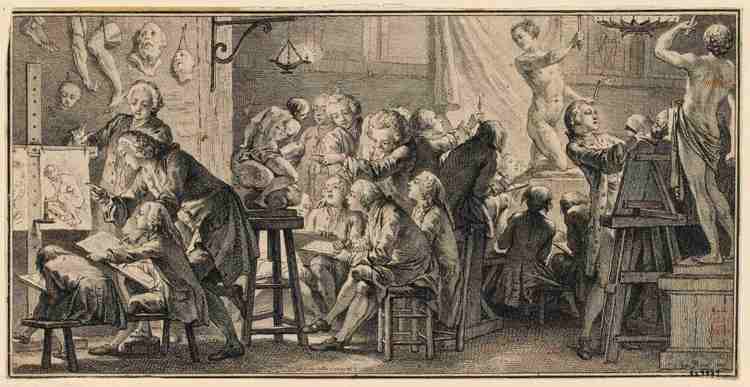 |
Musée Carnavalet, Paris École de dessin (detail) by Benoît-Louis Prévost, after Charles Nicolas Cochin fils, 1715–1790, from 'Recueil de planches', plate 1, vol II, 1763 |
Cutting and Pasting in 18th-century France
| By Roderick Conway Morris | LONDON 28 August 2025 |
'From the moment a cavalier arrives at a Lady's house, he is presented with an image, he takes his scissors from his pocket, he cuts out. It is a new genre of merit to know how to cut out well,' reported the 'Mercure de France' in December 1727. Earlier in the same year the anonymous author of the pamphlet 'Les découpures à la mode. Lettre à Monseigneur le Prince de ****' dilated on the risk of social suicide attached to an incompetent flourish of the scissors; the outings to the Comédie and Opéra truncated by an overwhelming compulsion to hurry home to another session of découpage; and mistresses won and lost over 'Harlequins, Monkeys, Crocodiles, & other bizarre figures in paper'.
Yet, as David Pullins, a curator at the Metropolitan Museum of Art argues, the fad for découpage, far from being merely a 'fashionable fury for cutting out coloured prints' (as another correspondent in 1727 styled it), has much wider implications for our understanding of the visual arts of the period. For in his meticulously researched and eminently readable 'The Mobile Image: from Watteau to Boucher' he persuasively demonstrates that this fragmentation of images was reflected in the training, ways of seeing and daily practices of contemporary fine and applied artists, which in turn profoundly influenced their patrons and the tastes of the era.
Art education methods in France, which can be traced back to those of Italy's academies in the 16th century, were well established by the following century. Students were initially taught to draw eyes, ears, mouths, for example, before composing an entire head. 'Each part of the body is particularized, before drawn in its entirety,' as Charles-Henri Watelet had it in his text on 'Dessin' in Diderot and d'Alembert's 'Encyclopedie's Recueil de planches' (1762–72). A detail from 'École de dessin' in this collection, illustrates (from left to right) the successive stages of a student's education, starting with drawing from drawings, moving on to drawing casts of body parts, then entire figures, and finally from the live model.
Only a tiny proportion of students and artists – let alone artisans – ever had the chance to draw from live models, but the so-called académies (drawings) that resulted from these sessions were widely circulated. They were copied and in due course became ever more readily available to artists, artisans and amateurs through prints. This fostered a lucrative market – driven partly by ardent découpeurs – in such stand-alone images. As another correspondent in the 'Mercure de France' in December 1727 noted: 'This fashion has made Images & prints rise to an extraordinary price; & because there are few Merchants who sell them, or who colour them, their Boutiques are always crowded.'
One of the most prominent of these dealers was the engraver and collector Gabriel Huquier (1695–1772). His trade card entitled 'Estampes differentes pour l'Étude de Dessein' ('Various prints for the study of drawing/design'), shows a shop with shelves lined with folders labelled according to artists and genres, among them académies, animals, architecture, interior design and ornaments.
Some rare surviving examples of privately owned bound volumes with prices added up by Huquier on the end boards indicate that customers could create their own personalized luxury scrapbooks from the dealer's stock. Huquier also published collections of prints. He advertised those after Watteau as 'of great use to Painters, Fan-makers, Sculptors, Metalworkers, Weavers, Embroiderers, etc.'. The publisher shrewdly realized the exceptional appeal of Watteau's works to the widest possible spectrum of artists and applied artists, since this painter and draughtsman was able 'to adjust so well his subjects to his ornaments and his ornaments to his subjects'.
Jean de Jullienne made Watteau's entire known oeuvre available with the publication of his 495 prints of Watteau's drawings and paintings in the so-called 'Recueil Jullienne'. The project was begun while Watteau was still alive, but most of the contents were etched and printed between 1726 and 1735, that is to say, after his untimely death in 1721 at the age of thirty-six. The publication was originally marketed at a price affordable for artists and artisans, and it had an enormous impact far beyond the realm of painting, with Watteau motifs becoming immensely popular in the decorative arts, from porcelain and textiles to inlays and lacquer work.
Watteau's piecemeal manner of working mirrored the promiscuous employment of images in diverse contexts in contemporary visual culture and the fashion for combining them in personalized albums. One of the primary aims of the Académie Royale de Peinture et de Sculpture was to distinguish the Parnassus of fine art from the banausic lower slopes of the applied and decorative arts. Yet as Watteau's fellow Academician and biographer the comte de Caylus had to admit in his address to the Académie in 1748: 'His custom was to draw his studies in a bound book so that he always had a large number at hand…When he had need of one for making a painting, he had recourse to his collection [recueil]. He would choose a figure from there that struck him as best for the moment. He formed his groups from them, most often in the light of a landscape ground that he had already conceived or prepared.'
The British Museum's current exhibition, 'Colour and line: Watteau Drawings', mostly from its own holdings and curated by Grant Lewis, provides some striking demonstrations of how the artist, rather than working up preparatory drawings in the approved academic manner for particular paintings, artfully employed cut-out figures, as it were, from his existing collections of images, often without any, or with only minor, adjustments.
We find on display, for example, drawings related to two protagonists in 'Les Divertissements Champêtres' of 1719–21: in the right foreground of the canvas is the right-hand figure from his drawing 'Two Women' (Pl 5) – with the addition of a rose that she is tucking into her bodice; while 'Woman seen from behind' appears in the far background of the painting.
Figures from another two drawings, 'A standing man and Man and a woman' (of a gentleman assisting a lady to her feet), feature in the 'L'Embarquement pour Cythère' of 1717 (Louvre, Paris).
There was no market in drawings by Watteau during his lifetime because he refused to sell them, clearly regarding them as a precious resource for future use, keeping them, as his biographers attested, in livres reliés (bound volumes). Even his most faithful patrons, such as the comte de Caylus and Pierre Crozat, only obtained them as posthumous gifts. Nor did he only deploy these images in his own paintings. When Philippe Meusnier the elder (1655–1734), for instance, was commissioned to do three canvases for Louis XIV, for one of a church interior 'Watteau was ordered for the pretty figures'.
Returning to Pullins's book, the third artist he focuses on, after Watteau and François Boucher (1703–1770), in his absorbing account of 'part-to-whole construction' (as he puts it), is Jean-Baptiste Oudry (1686–1755), whose attitude to his drawings paralleled that of his near-contemporary, Watteau. As his biographer the abbé Louis Gougenot recorded: 'M. Oudry was, in a certain sense, more attached to his drawings than to his paintings; from them he formed portfolios each composed of fifty works, [each] so varied that in possessing one of these albums one was sure to have something in all genres that he embraced. He regarded them as a reserve [un fonds] that he accumulated for his family. They were almost never seen during his lifetime.'
From the time of Poussin onwards the rectangular canvas became a clear marker of academic art, distinguishing it from forms of merely decorative art. But the first part of the 18th century was a challenging period for painters, including those, such as Watteau, Oudry and Boucher, who had a foot in both the academic and decorative camps. The increasingly elaborate rococo designs in the socially highly competitive world of interiors constantly threatened to reduce painting from a noble art to a mere element in décor.
A particularly alarming threat was the craze for mirrors, which were hugely more costly than paintings. As La Font de Saint-Yenne complained in his 'Réflexions sur quelques causes de l'état présent de la peinture en France' (1747): 'The science of the Brush has therefore been forced to yield to the shimmer of glass; the mechanical facility of its perfection & its abundance have banished the finest of the arts [painting] from our apartments; the only refuge left to it being to fill in a few miserable spaces, overdoors, overmantels, & a few pier mirrors reduced in height for the sake of economy'.
The demands of contemporary décor led to increasingly elaborately shaped picture frames, which came to be described as 'chantourné (literally, 'scooped out'). The term first appeared in the Salon's livret in 1738 and became standard thereafter. Boucher's Astronomy and Eloquence was described in the Salon livret of 1746, for example, as 'A Painting in the chantourné form' (in reality, a pair of pictures). Such formats inevitably smacked of decorative art, which in theory had no place in the Salon, one of the primary functions of which was to display the glories of classically inspired French academic art. As Pullins points out, however, in the final section of his book, which revealingly delves into this issue, such pictures did find a place in the Salon that otherwise would have been 'often robbed from the eyes of the public', in the words of an early guide to the exhibition.
Nevertheless, the pressure to conform to more standard formats was strong. A telling example, illustrated by Pullins, is that of a series of allegorical paintings by Carle van Loo (1705–1765) of 'The Fine Arts' (1752–53), destined for Madame de Pompadour's château de Bellevue. These were designed for shield-like frames (as attested by prints of them dated to 1756), but subsequently adjusted into rectilinear formats, which reduced the harmony of their original designs, in order to render them acceptable to the expectations of the Salon.
Madame de Pompadour would not have indulged in anything so commonplace as buying a picture off the peg. As Christian Michel, quoted by Pullins, has remarked, she preferred to commission works specifically to fit the interiors of her various residences. Significantly, Boucher's 'Portrait of Madame de Pompadour' of 1756 sets her, amid an abundance of luxurious fabrics, not against some masterpiece on canvas (she was already fulfilling that role) but a gigantic gilt-framed mirror reflecting a large rococo clock.
While the Académie affected to look down from its Olympian heights on decorative art, the critics at the Salon seem to have ignored, or been ignorant of the fact, that the prevailing methods of cut-and-paste production were shared across the board. Repetitions of almost identical figures from one Salon to another or even in different works in the same Salon were passed over by the critics in silence – although Diderot did remark of Boucher's 'Jupiter and Callisto' (Metropolitan Museum of Art, New York) in 1763, 'It's his old figure turned around and moved about.'
Ironically, practitioners of the genres of decorative or minor arts deprecated by the Académie could on occasion gain access to the upper echelons of society beyond the dreams of many academicians. The portrait miniaturist Jean-Baptiste Massé (1687–1767), for example, was taken up the aristocracy and even royalty. And it was his, not Oudry's, election as an academician that was to prove decisive in the latter's career. As Oudry's earliest biographer abbé Louis Gougenot noted in his 1761 address to the Académie, 'However glorious these new marks of distinction were for M. Oudry, he did not enjoy greater ease. Knowledge of his merit, concentrated within the Académie, had not yet made headway with the greats. M. Massé, his old friend, paved his first routes.'
'The Mobile Image: from Watteau to Boucher' by David Pullins, Getty Publications 208 pp £50
Colour and Line: Watteau Drawings, British Museum, London, 15 May–14 September 2025
Note: All the drawings in the temporary show reviewed above are permanently available online on the British Museum's website.
A fully illustrated version of this article can be found at:
britishartjournal.co.uk/watteau-and-cutting-and-pasting-in-the-18th-century/
First published: British Art Journal: Online
© Roderick Conway Morris 1975-2026