 |
Painting Light
| By Roderick Conway Morris |
LONDON 8 January 2026 |
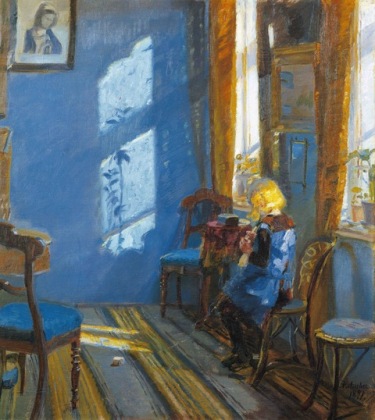 |
Skagens Museum Sunlight in the Blue Room by Anna Ancher, 1891 |
When Hans Christian Anderson (1805–1875) visited the fishing village of Skagen on Denmark's remotest northern tip in 1859, he found a wilderness of shifting sands 'between two roaring seas', the air filled with the cries of wild birds and a habitation 'which has no paved streets or alleys'. In 'A Story from the Dunes' he urged others to make the journey: 'If you are a painter, then follow us up here, here there are subjects for you, here there is scenery for poetry.'
He stayed at the Brøndum family hotel, the only one in town. According to family lore, the terror spread by the irascible author's demands induced the owner's pregnant wife, Ane Brøndum, precipitously to give birth to a daughter, Anna (1859–1935). Within a few years painters did indeed follow Andersen to Skagen and Anna, as in some fairy tale, became throughout the land the most admired and famous of them all.
This richly rewarding artist is now the subject of an exhibition at the Dulwich Picture Gallery. It is expertly curated by Helen Hillyard, Head of Collection at the Gallery, and accompanied by an excellent catalogue, with invaluable contributions from the Curator of the Skagens Museum, Mette Harbo Lehmann.
The first artists to arrive in Skagen in 1872 were the Norwegian Frits Thaulow (1847–1906) and Danish painter and poet Holger Drachmann (1846–1908), when Anna was 12 years old. Others soon came to join them and all inevitably stayed at her parents' hostelry, adorning its walls with their works. From these early visitors Anna began to learn how to draw. In 1874 the Danish artist Michael Ancher (1849–1927) made the four-day trek from Copenhagen. That summer Anna turned 15 and, after returning in January, the capital Michael sent her a portable painting box, writing: 'Now be diligent about drawing and let it be your goal to become a painter, and everything will most likely go well.'
Artists' lives, especially those of women, are littered with stories of hardships, disappointments, humiliations, unfulfilled destinies, recognition late in life or even only after death, but circumstances almost miraculously conspired to smooth Anna's path. Her mother Ane was not happily married and put no pressure on her or her sisters to marry.
In 1875 Anna went off to study at a private art school in the capital – the Royal Danish Academy was yet to accept women students – run by Vilhelm Kyhn (1819–1903). A letter from her mother assured Anna shortly after her arrival: 'You must write and say what you need. Nothing is dearer to me than to pay for your learning, you know that.' Anna returned to the school for two further winters, going back to Skagen every summer where she continued her education with the ever-expanding community of artists, which was taking on an international flavour with arrivals not only from other Scandinavian countries but also France, Germany and Britain. Anna remained unique, however, in being Skagen-born and bred and, at a remarkably early age, came to be recognized as the colony's presiding genius. She exhibited for the first time in Copenhagen in 1878 and again the following year. Her only known self-portrait dates from this time.
In 1880 on her 21st birthday Anna married Michael Ancher, taking his name, and in the same year she made her debut at the Charlottenberg Salon in Copenhagen, where she was to exhibit every year but two until her death in 1935. Her first Salon offering was 'Old Man Whittling Sticks' (on show here), in the naturalistic style then dominant among younger artists. Her husband Michael, although a talented artist himself, was supportive of his wife's career from the start. Their jointly painted 'Judgement of a Day's Work' (1883) shows the couple assessing a canvas by lamplight, in which prophetically his wife takes centre stage as he takes a back seat in the shadows.
In 1883 Ancher had her only child, a daughter Helga, who would herself go on to become a painter. Her former teacher Khyn wrote to her urging her to throw her pochade box in the sea and devote herself to family life. But she was the only one of her siblings ever to have offspring. Three of them continued to work at the hotel and all seem to have been willing to take on child-minding duties, allowing Anna to devote herself to painting.
It also made it possible for the Anna and Michael to travel extensively during the 1880s to visit museums and galleries in Berlin, Dresden, Munich, Vienna, Paris, the Netherlands, Belgium and Britain. In 1889 they spent six months in Paris, where Anna attended the schools of Puvis de Chavannes (1824–1898) and Alfred Philippe Rolo (1846–1914). Both she and Michael exhibited along with 50 other Nordic painters (many of them women) at the Exposition Universelle, which attracted 32 million visitors.
Nonetheless, while her style changed radically during this period, her subject-matter remained firmly rooted in her hometown. As she once recorded: 'I firmly believe that the very best thing is to go on small trips, but staying mainly at home and painting the people in one's own country.'
Her sitters were mainly drawn from the local townsfolk, fishermen, smallholders and their families, her own family and friends. She did a series of studies on the theme of the seamstress over several years, such as 'Study of a Seamstress in Blue'.
The settings embraced the various salons of the Brøndum Hotel, her own home and garden – for example 'A Girl in the Garden, Skagen' – neighbours' rooms and kitchens, the doctor's surgery, a girls' sewing school. She had the advantage over the other Skagen painters in having known these people all her life and being able to speak the near-impenetrable northern Jutland dialect.
Ancher's 1879 self-portrait records her distinctive profile, the result of having broken her nose in a childhood accident, making it possible easily to identify her in many of the over 5,000 contemporary photographs now at the Skagens Museum. The entire dining-room of the Brøndum Hotel, with the visiting artists' portraits, local scenes and still lifes set into its wooden panelling, was transferred to the Museum in 1946. Her home was also opened as a museum in 1967.
A feature that once enticed adventurous travellers to the lengthy journey to Skagen was its position on a narrow spit land where two seas, the Skagerrak and the Kattegat, meet and constantly vie for supremacy. This phenomenon was reputed to produce a unique light and perhaps contributed to Ancher's lifelong fascination with light. She sought inspiration especially in some of the painters of the Dutch Golden Age and the French Impressionists. Among the former, Pieter de Hooch and Johannes Vermeer were being rediscovered in the second half of the 19th century, and they greatly influenced her depiction and lighting of interiors.
During her formative years Ancher benefited from an unusually wide range of informal teachers from the among the varied artists who frequented Skagen every summer. That she was not Academy trained seems to have been an advantage in forming her own distinctive style. 'The Maid in the Kitchen' from the mid 1880s is reminiscent of both Vermeer and De Hooch, but is convincingly more rustic in flavour. The canvas was exhibited at the 'Exhibition of Works by Danish Painters' at the Guildhall Gallery in London in 1907.
The free spirit that informed both her life and the direction her art took is nicely illustrated by an anecdote about how she decided to join this painting in London at the last minute. While at the station in Copenhagen, seeing off a fellow artist and exhibitor, Laurits Tuxen (1853–1827), who was on his way to London with his wife, she boarded the train as it departed, leaving a message asking her family to send clothes on after her. Her picture was one of the last bought by the Danish collector Heinrich Hirschsprung (and is on loan from that permanent collection in Copenhagen).
By the end of the 1880s, emboldened by her recent peregrinations, which had made her familiar with both Old Master paintings and contemporary movements around Europe, Ancher was sufficiently confident to make works primarily devoted to the study of light, a subject that was to engage her for the rest of her career.
Her 'Sunlight in the Blue Room' (1891), of her daughter Helga knitting in a private dining room at the Brøndum Hotel, received a mixed reception. When the canvas was displayed at the Spring Exhibition at Charlottenberg in 1892, some critics opined that although it was acceptable to experiment, such pictures were better not shown outside an artist's atelier. One at least was enchanted, recording: 'By Mrs Anna Ancher, there is an absolutely lovely interior painting, 'Sunlight in the Blue Room', in which the colour effect is extremely fine.'
Some of the artist's most memorable canvases capture those closest to her but artfully composed to make it seem as though they are entirely absorbed in their own worlds and oblivious to her presence. 'Lunch Before the Hunt' (1903) depicts her husband Michael in their dining room, hat pushed back, as he concentrates on a solitary repast; and 'Interior with Red Poppies' (1905) portrays her friend the pianist Lizzy Hohlenberg, absorbed in reading at the Ancher's dining table, with a pyrotechnic display of enormous red flowers in a vase, the woodwork of the beautifully rendered, highly polished table, sofa and chairs catching the sunlight.
Empty rooms also afforded opportunities for Ancher to focus entirely on the effects of brilliant light illuminating bare walls, as in her intriguing and atmospheric 'Interior: Brøndum's Annex'. In this and other pictures she caught patches of sunlight on walls by painting them in a thick, rough impasto, the minute facets of which reflect the light on the surface of the canvas – a technique she seems to have learned from Rembrandt.
For nearly a century Ancher was mainly celebrated for her interiors but, after the merging of the Skagens Museum and Anchers Hus (Ancher's House Museum) in 2014, a large cache of undocumented works, many of them exterior scenes and landscapes, was discovered. The pictures were stacked in drawers on top of each other, and they have initiated a re-evaluation of her output. Among these were atmospheric works such as the tranquil 'Blue Sunset', in which one can almost hear the waves gently lapping on the shore. This and other landscapes bear witness to her interest in the Impressionists, especially Monet.
Ancher was also alive to developments in Post-Impressionism. In Paris she would have seen works by Gauguin whose Danish wife, Mette, retained a collection of his paintings in Copenhagen after their marriage broke up. Ancher's depiction of one of Skagen's still sandy streets, 'Osterbyvej', for example, is executed with blocks of colour, a device characteristic of Gauguin and other Post-Impressionists, although the show's curator Helen Hillyard suggests that Ancher might have considered pieces like these, which were never exhibited in her lifetime, to be sketches.
Ancher also artfully used bold bands of colour in a series of exhibited paintings created between 1900 and 1905 focusing on agricultural workers, as in her 'Harvesters', which is both affectionate and amusing, and brings to mind medieval friezes featuring the scythe-bearing Grim Reaper, in this case a rosy-cheeked, sun-tanned Jutland farmer.
We know little about the artist's working practices because she seldom refers to them in her letters, and she jealously guarded the privacy of her studio. But we get a tantalizing glimpse behind scenes in an outstanding rediscovered piece, 'Evening Sun in the Artist's Studio at Markvej'. It is strikingly displayed here unframed, since it remained so during her lifetime. She would very probably have considered it too minimalist (and private) to be publicly shown. Yet it constitutes a kind of 'Essence of Ancher', and bears witness to her lifelong striving to capture the magical properties of light.
Anna Ancher: Painting Light, Dulwich Picture Gallery, London, 4 November 2025–8 March 2026
'Anna Ancher: Painting Light' by Helen Hillyard and Mette Harbo Lehmann, Dulwich Picture Gallery, 160 pp £25
A fully illustrated version of this article can be found at:
https://britishartjournal.co.uk/anna-ancher-painting-light/
First published: British Art Journal: Online
© Roderick Conway Morris 1975-2026