 |
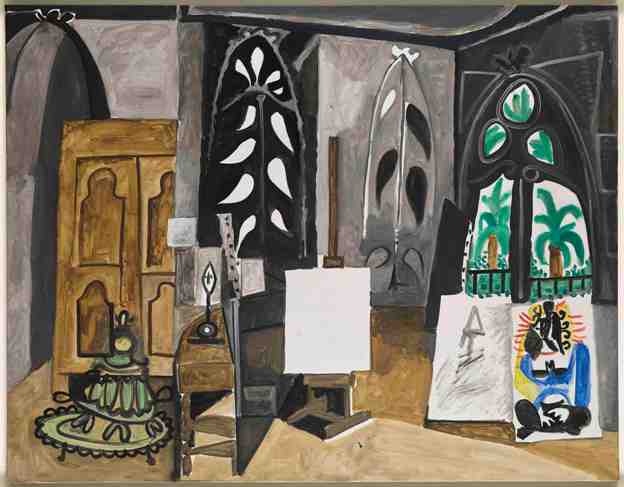 |
Musée National Picasso-Paris/photo Mathieu Rabeau The Studio at La Californie by Picasso, 1956 |
From the Studio
| By Roderick Conway Morris | DUBLIN 1 December 2025 |
'The way an artist arranges the objects around him is as revealing as his creations,' Picasso (1881–1973) told the Hungarian-born photographer Brassaï (1899–1984) in December 1943.
In December 1932 Brassaï went with Picasso to Boisgeloup in Normandy, which the artist had bought a couple of years earlier. The images he captured there were published in the inaugural edition of the surrealist magazine 'Minotaure', for which Picasso provided the cover artwork. Over the next decades Brassaï returned again and again to record the artist and his works at his various studios. Other now famous photographers, including Henri Cartier-Bresson, Lee Miller, Dora Maar, Frank Capa and Douglas Glass, followed in Brassaï's footsteps and the artist was astute in cultivating them to promote his own image.
A number of these photographs punctuate an engaging and thought-provoking exhibition, 'Picasso: From the Studio', curated by Janet McLean at the National Gallery of Ireland (NGI) in Dublin. This tour d'horizon of the artist's works in multiple media explores the central role that the locations and spaces of Picasso's studios had on the works that he produced in them. Almost all the judiciously chosen pieces are on loan from the Musée Picasso in Paris, which has a collection unparalleled in its scope with over 5,000 works representing every period of the artist's career and 200,000 archive holdings, supplemented with pieces from the NGI's own permanent collection.
After earlier sojourns Picasso settled in Paris in 1904. His first studio was in the bohemian artistic complex the Bateau-Lavoir in Montmartre, where he was based until 1909 and maintained a studio until 1912. During this time the Bateau-Lavoir became a factory for the avant-garde and a crucible for Cubism. Here he met the poet Apollinaire who, in 1907, introduced him to Georges Braque (1882–1963). The two artists worked so closely together that their works became indistinguishable, Braque describing their relationship as being akin to two mountaineers roped together.
Among the first works in the Dublin exhibition is Picasso's classic Cubist papier collé 'Bottle and Newspaper' (1912). It was bought by the Irish artist and later renowned maker of stained glass Evie Hone (1894–1955) at one of the auctions held in Paris between 1921 and 1923 of Picasso's German-Jewish dealer Daniel-Henry Kahnweiler's collection, which had been seized by the French Government during the First War. Hone was studying there at the time and bequeathed the work to the NGI in 1955.
By 1909 Picasso was cohabiting with Fernande Olivier (1881–1966) and was tiring of the bohemian life. The couple moved to a new apartment (with maid) and studio near Place Pigalle, where the couple held regular Sunday open houses and from which the artist sold paintings to the likes of Gertrude Stein, the Russian collector Sergei Shchukin, and dealer and publisher Henri Vollard.
From 1916 onwards Picasso became intensely involved with the theatre, designing curtains, stage sets and costumes. In that year Jean Cocteau (1889–1963) introduced him to Serge Diaghilev (1872–1929), the entrepreneur of the Ballets Russes, and Picasso went on to design four ballets for the company by 1924. In 1917 the artist travelled to Rome to work on their production of Parade, during which time he found a new muse, the Russian dancer Olga Khokhlova (1891–1955), whom he married the following year in Paris.
This change in his ménage and his wife's social ambitions prompted him to move to grander residential and studio premises at 23 rue La Boétie, in the 8th arrondissement, then at the centre of the contemporary art gallery scene. It also marked the beginning of the period when Picasso and his family began to spend their summers in fashionable resorts such as Dinard, Cannes and Antibes. In the summer of 1920 the artist rented a villa in Juan-les-Pins, where in one of a series of temporary studio spaces he painted one of his characteristic sunny, idealized Mediterranean canvases, 'Landscape of Juan-les-Pins' (1920), on display here.
The Riviera was already a popular winter refuge for well-heeled British visitors but the American socialites Gerald and Sara Murphy led the trend to gather there during the summer months with their friends, Scott and Zelda Fitzgerald and the Picassos among them, and these visits to the Côte d'Azur helped the artist to promote his work in the US.
He painted his 'Still-life with a Mandolin', an evocative, nocturnal Mediterranean image, in his garage studio in Juan-les-Pins in 1924. It was bought by Sara Murphy's sister, the collector and critic Mary Hoyt Wiborg, along with two other Picasso canvases. She lent 'Still-life with a Mandolin' to a series of exhibitions, including at the Met in New York and the Arts Club Chicago, and actively promoted the artist on the other side of the Atlantic. It was eventually bequeathed by Máire MacNeill Sweeney to the NGI in 1987.
Picasso's purchase of the Normandy manor house at Boisgeloup in 1930 led to two major developments in his personal and artistic career. Picasso had produced his first sculptures around the turn of the century. The large spaces offered by a stable block at Boisgeloup gave him the chance to fashion much larger pieces. Their existence remained virtually unknown until Brassï recorded them. That master of night photography also memorably dramatized them by using his last remaining plate for a 'group' shot of them lit by an oil lamp.
Boisgeloup also allowed the artist to live a double life. In 1927 he had met Marie-Thérèse Walter (1909–1977), a sporty Frenchwoman nearly 30 years his junior, with a bronzed, Junoesque physique and short blonde hair. In due course she became his lover. She regularly visited and sat for him at Boisgeloup for both paintings and sculptures while Olga and his son Paolo continued to live in Paris.
A major challenge was approaching in 1932 in the form of a retrospective exhibition in Paris in the summer of that year, an event then rare for a living artist. Picasso was determined to prove that even as he entered his 50s he was still capable of artistic innovation and self-renewal and, driven too by the wish to express his often tortured passion for Walter, he produced an extraordinary stream of works over a short period. In just two weeks at the beginning of March, for example, he painted seven pictures, including three reclining nudes and two still-lifes.
Pictures of Walter figured prominently in the retrospective in June. The relationship remained secret, but her distinctive profile repeated in many images made evident that the artist had a new muse – and it was news to Olga, too, that she had a rival. He continued to paint Marie-Thérèse until the late 1930s. By the time he executed the 'Portrait of Marie-Thérèse' in Paris in December 1937, he was already having an affair with the surrealist photographer Dora Maar (1907–1997). On occasion he even fused their images in the same picture.
In 1937 Picasso found an additional studio space, an enormous attic in the roof of a 17th-century town house on the rue des Grands-Augustins in Saint-Germaine-des-Près on the Left Bank. It was here that he created his mural 'Guernica', commissioned by the Spanish Republican Government in the Spring of 1937 for the Spanish Pavilion at the Exposition Universelle in Paris. Dora Maar made a notable photographic contribution to Picasso's fame with her sequence of images recording the production of this mammoth work. Interestingly, although there are a plethora of photographs of the artist and his studios, Maar's images of 'Guernica' are unusual in that some feature Picasso actually at work.
Picasso continued to paint Maar during the Occupation and one of his last portraits of her, 'Bust of a woman in a blue hat', made in Paris in March 1944, cruelly borders on the parodic (and teeters on the edge of self-parody).
Shortly after the Liberation of Paris in 1944, Picasso joined the French Communist Party. His new image of himself as a worker among workers was probably one of the reasons he established himself in the pottery town of Vallauris on the Côte d'Azur, between Cannes and Antibes in 1948. There he bought a villa and rented an old factory and perfumery as a studio. His townscape 'Smoke in Vallauris' (1951), faithfully records how, since many of the potteries then lacked chimneys, the smoke from their kilns simply billowed through holes in the roof. He approached his new life as a potter with a humility not always associated with him, declaring in an interview: 'I don't think I'm a ceramicist, next to ceramicists who are real ceramicists. I'm just an unfortunate amateur and an ignoramus. I try, I listen, I look.' Over the next few years he made over 6,800 pieces and a number of some of these striking hybrid creations, combining his sculptural and painting skills, are in the present exhibition.
His partner during these years was Françoise Gilot (1921–2023), a young painter whom he had met in 1943, while she was in her early twenties. They began to live together three years later and had two children, Claude (b 1947) and Paloma (b 1949). He made hundreds of drawings and paintings of his new family and it was clearly a severe blow to his ego when Gilot left him in 1953, returning to Paris with the children, after which they visited during the school holidays. The absence of his family produced an unusually tender and touching image, 'Claude drawing, Françoise and Paloma', painted eight months after Françoise had departed with them in May 1954.
In 1955 Picasso acquired a much grander and more luxurious Belle-Époque residence with lush gardens and views of the sea, La Californie, at Cannes. Here he worked in all the media that he had essayed during his long career, from painting and sculpture to etching and ceramics. The death of Olga, who had refused to divorce him, in that year left him free to marry his latest companion, Jacqueline Roque (1926–1986), which he finally did in 1961.
Numerous photographers documented this latest studio-residence. The artist himself had intermittently painted pictures of his studios during his career, but this time he devoted himself in a more concentrated fashion to the theme. Between October 1955 and November 1956 he made three series of paintings in which it took centre stage. One group constituted a homage to his old friend Henri Matisse, who had died in 1954. 'The Studio at La Californie', dated 30 March 1956, on display here, is richly redolent in style of Matisse's works and contains many of his familiar motifs, including Moorish windows, palm trees, cut-out leaves and a Moroccan brazier. In the middle of the picture is a suggestive blank canvas on an easel. Picasso described these paintings as paysages d'intérieurs (interior landscapes), and, as Joanne Snrech of the Musée Picasso observes in her introduction to the catalogue, they can be seen 'almost as self-portraits'.
Michelangelo was reputed to have destroyed his preparatory drawings and other documents before his death lest they undermine his posthumous image as the perfect genius. Picasso, on the other hand, said to Brassaï: 'I want the documentation I leave to posterity to be as complete as possible.' He was a life-long hoarder and seems never to have thrown anything away. Jean Cocteau dubbed him 'Le Roi des Chiffonniers' (King of Rag-pickers) and Françoise Gilot described him on their walks together wheeling an old pram into which he would throw random discarded objects, dispatching his driver later to collect any too large to be accommodated.
When he moved from La Californie in 1961 to his last residence at Mas Notre-Dame-de-Vie at Mougins, he left this entire artful arrangement of objects behind. And after the artist died at Mougins, intestate, at the age of ninety-one, in April 1973, his son Claude and the filmmaker Thierry Spitzer found La Californie almost as undisturbed as a pharaoh's tomb.
Picasso: From the Studio, National Gallery of Ireland, Dublin, 9 October 2025–22 February 2026
'Picasso: From the Studio' by Janet McLean and Joanne Snrech, National Gallery of Ireland, 118 pp €25
A fully illustrated version of this article can be found at:
https://britishartjournal.co.uk/picasso-from-the-studio/
First published: British Art Journal: Online
© Roderick Conway Morris 1975-2026