 |
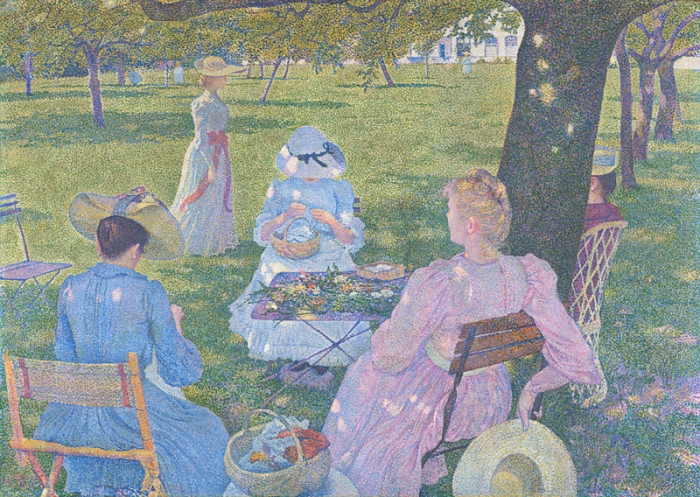 |
Kröller-Müller Museum, Otterlo In July, before Noon by Théo Van Rysselberghe, 1890 |
Radical Harmony: Helene Kröller-Müller's Neo-Impressionists
| By Roderick Conway Morris | LONDON 15 November 2025 |
'They see poetry in what I have done. No. I apply my methods, and that is all there is to it,' Georges Seurat is reported to have said, in a letter written by a fellow French Neo-Impressionist painter, Charles Angrand, to one of the former's principal disciples, Henri-Edmund Cross, in 1891.
Helene Kröller-Müller, who was to become the greatest 20th-century private collector of Neo-Impressionists, took a different, more elevated view when she wrote in August 1912 that Seurat had invented Pointillism to achieve 'a spiritualization of art: applying the colour to the canvas dot by dot in order to contemplate things more calmly and profoundly'.
Born in near Essen in 1869 and raised in Dusseldorf, Helene Kröller-Müller was the daughter of a wealthy merchant, Wilhelm H Müller, who founded a successful iron ore and shipping company in 1876. A Dutchman, Anton Kröller, came to work for her father in 1883. Helene married him in 1888 and they moved to Rotterdam, where there was a branch of Müller & Co. Upon the death of her father, Anton Kröller became the head of the company at the age of twenty-seven. He built it up into a thriving international concern, with branches in Antwerp, London, Paris and New York, and elsewhere. In around 1900, Kröller decided to move to The Hague. This marked the beginning of his wife's interest in collecting, as she bought furniture, Delftware and other ceramics, and Chinese art to decorate their new residence.
Having survived a hazardous surgical operation in 1911, Kröller-Müller resolved to use the family's immense wealth to transform her collecting into a more ambitious project 'for the benefit and enjoyment of the community'. Highly unusually for the times, Kröller-Müller joined Müller & Co. as managing partner. In 1913, she opened the first Kröller Museum in The Hague. The works stretched from the French Realists and the Barbizon School, through the Impressionists, Symbolists and Neo-Impressionists to Cubism and De Stilj. The heart of the collection came to comprise some 272 works, including 90 paintings by Van Gogh (now the largest holding of the artist's work outside the Van Gogh Museum in Amsterdam).
A second museum project, for which the foundations had been laid on the family's 7,000 hectare estate, De Hoge Veluwe, had to be abandoned in 1922 when the economic crisis brought Müller & Co. to the brink of bankruptcy. In 1935 the estate was bought by the Dutch state, becoming the Foundation National Park De Hoge Veluwe, along with the collection and a promise to build a museum to house it. The Rijksmuseum Kröller-Müller was opened to the public in July 1938, with Helene acting as its first director until her death in December 1939.
This unique collection has now lent nearly 60 of its key works to the National Gallery in London, for an impressive and absorbing exhibition, 'Radical Harmony: Helene Kröller-Müller's Neo-Impressionists', supplemented by some relevant pieces from other sources. The show is accompanied by an attractive, informative and generously illustrated catalogue, which will also serve as a good general introduction to the movement. Among the star attractions of the exhibition is Seurat's 'The Channel of Gravelines, Direction of the Sea', painted shortly before his death in 1891.
A major strength of Kröller-Müller's collection is that, while acquiring classic works by the French Neo-Impressionists Seurat, Signac, the Pissarros, Henri-Edmond Cross and Maximilien Luce, she also assiduously bought canvases by the Dutch Jan Toorop and Johan Thorn Prikker, and the Belgian Théo Van Rysselberghe, Henry Van de Velde and Georges Lemmen. Indeed, Kröller-Müller's last purchase of a Neo-Impressionist work, in 1930, was of Théo Van Rysselberghe's luminous, sun-dappled 'In July, Before Noon'.
Impressionism had sought to represent the world in a novel, less literal, more spontaneous manner. The first fruits of Neo-Impressionism were displayed at what turned out to be the Eighth and last Impressionist Exhibition in 1886 when, against the opposition of the existing members of the group, Seurat showed seven canvases, including 'Sunday Afternoon on the Island of La Grande Jatte', 1884–86 (now at the Art Institute of Chicago) and Signac eighteen. They were banished to a separate room, where Claude Pissarro and his son Lucien joined them in a gesture of solidarity, the father having written to his son ,'I am totally convinced of the progressive nature of this art, and certain that in time it will yield extraordinary results.'
The term 'Neo-Impressionism' was invented the following year by Félix Fénéon, who went on to publish an article entitled 'Le Néo-Impressionisme' in the Belgian journal 'L'Art Moderne', in which he wrote that 'objective reality is for them only a pretext for the creation of a higher and sublimated reality, which becomes infused with their personalities'.
The new technique was driven by scientific studies of colour and optics by the likes of Michel-Eugène Chevreul, Charles Blanc, Ogden Rood and Charles Henry. According to the chemist Chevreul, Director of Dyeing at the Gobelins textile factory in Paris, the juxtaposition of such colours as blue/orange, red/green and purple/yellow could produce 'the most remarkable brilliance, strength and purity'. Elaborating on this, in the view of the art critic Blanc two such colours 'form a third colour that our eye will perceive at a distance'.
Applying these theories on canvas, Seurat developed 'Pointillism', although he himself preferred the term 'Chromoluminarist', which was too ungainly ever to become popular. Signac, Seurat's most important early follower preferred the term 'Divisionism' (still standard, for example, in Italy). This was not least because, as he asserted in his treatise 'From Eugène Delacroix to Neo-Impressionism' (1899), 'Divisionism in no way requires a touch shaped like a dot…the size of the divided touch must be proportioned to the size of the work.' In the hands of some artists these marks became dashes or like mosaic tesserae.
Seurat and Signac, both of whom had received a traditional art training, also found themselves having to defend themselves against accusations that the new technique was essentially mechanical. As Signac wrote, the Neo-Impressionists' 'precise scientific method does not disable their power to sense, it guides and protects it'. However, as, for example, Signac's 'Saint-Briac, the Beacons, Opus 210' illustrates, his early Divisionist endeavours were extraordinarily similar in style to Seurat's work.
The overarching title of the exhibition, 'Radical Harmony', appears partly inspired by Seurat's remark in a letter to the journalist Maurice Beaubourg in 1890: 'L'Art c'est l'Harmonie.' He attempted to clarify this gnomic, rather woolly, concept by adding the scarcely more enlightening: 'Harmony is the analogy of contrary and similar qualities of tone, colour and line.'
Seurat certainly saw himself as the leader of a new avant-garde in art but he seems to have been little interested in active radical politics. A number of other Neo-Impressionist artists, on the other hand, espoused radical political movements and used their art to promote them. Paul Signac, Camille Pissarro and Maximilien Luce were all avowed anarchists. Luce, the author of sympathetic depictions of the working classes, such as the 'Iron Foundry' (1899) and 'Morning, Interior' on display here, was imprisoned for 42 days in 1892 for his anarchist associations.
Also here are the Dutch artist Jan Toorop's grim pair of canvases of 1888–89 entitled 'Evening (before the Strike)' and 'Morning (after the Strike', in the latter of which a mournful family are shown (with clear suggestions of a 'Pietà') trudging home with a lifeless corpse. In 1894, Félix Fénéon, the Neo-Impressionists early champion, was accused of the anarchist bombing of a Paris restaurant, for which he stood trial (and was acquitted).
Signac's anarchism was the antithesis of the nihilistic, bomb-throwing variety, as he eloquently demonstrated in his vision of peace and harmony lived according to anarchistic principles in his 'In the Time of Harmony: The Golden Age Has Not Passed; It is Still to Come' (Mairie de Montreuil, Paris, 1893-95). The scene, set on the French Riviera, was painted after he moved near to St Tropez in 1892 (a preparatory study is on show here). He even ingeniously argued (in 'From Eugène Delacroix to Neo-Impressionism'): 'For a colour to be beautiful, it should influence its neighbour by harmonising with it and subduing it, for their common benefit. From this charming duo is born perfect harmony.'
Seurat's 'La Grand Jatte' caused a sensation when it was first exhibited at the Eighth Impressionist Exhibition, but critics were sceptical that this new method could be successfully applied to other genres, notably the nude. His riposte took the form of 'Les Poseuses' (Barnes Collection, Philadelphia, 1886–1888), a genuinely radical picture in several ways beyond mere technique. A small version of 1888 from a private collection is on display here.
Not only did the artist take the opportunity to advertise his own wares by using his 'La Grande Jatte' as a partial backdrop, but the canvas was also replete with classical references, including antique statues such as the The Three Graces, Venus Pudica and the 'Capitoline Spinario'. And, as Michelle Foa acutely observes in her 'Georges Seurat: The Art of Vision' (2015), the artist overturns 'the long-standing precept that a painting conveys a single moment in time, instead depicting the model as she undresses, poses for the painter, and gets dressed again'.
Paul Signac's interiors, although executed in the new style. Were palpably influenced by compositions by his friend Gustave Caillebotte. This Impressionist and most prominent patron of that movement also taught Signac to sail.
Signac's 'The Dining Room, Opus 152', of his own family at their breakfast, owes a clear debt to Caillebotte's 'Luncheon' (Private collection, 1876), while his 'A Sunday, Opus 201' (1889-90), a study of froideur in a haut-bourgeois marriage, is indebted to Caillebotte's 'Interior, Woman at the Window' (Private collection, 1880). The critic Jules Christophe noted in Signac's latter picture 'a spirit of observation worthy of a highly accomplished novelist'.
Seurat shared the enthusiasm of many fellow artists for dance hall and cabarets as potential subjects for art. He also 'adored the genius' of the poster designer Jules Chéret (1836–1932) and such manifestations of popular art were one of the inspirations behind the Le Chahut depicting this particularly vigorous version of the cancan.
'Le Chahut' also reflects the application of theories propounded by the mathematician and psychologist Charles Henry in his 'Introduction à une esthétique scientifique' (1885), which argued that the direction of lines could convey specific feelings: rising lines could produce gaiety and downward lines sadness, and so on. The Belgian Post-Impressionist painter and architect Henry Van de Velde declared in an article in 1890 that 'Le Chahut' was the artist's 'first work following a system of lines'. Helene Kröller-Müller bought the picture at auction in 1922 and it is on loan for the first time since 1958.
The closing highlight of this exhibition is the bringing together of three of the four paintings Seurat executed at Gravelines, a small port on the flatlands of the north-eastern French coast, in 1890, before his untimely death from an infection at the age of 32 in March 1891: 'The Channel of Gravelines, Direction of the Sea'; 'The Channel of Gravelines, Grand Fort-Philippe'; and 'The Channel of Gravelines, an Evening'. They were conceived to be exhibited together, but to view the fourth one, 'The Channel of Gravelines, Petit Fort-Philippe' (Indianapolis, Museum of Art), we shall have to wait until next year's exhibition at the Courtauld, 'Seurat and the Sea', which will explore in more depth the marine paintings that made up such a central part of his oeuvre (13 February -26 May 2026).
Despite Seurat's disclaimers of more sublime aspirations, when Kröller-Müller acquired her component of the sequence in 1913, she wrote of the artist: 'He sees the view of the harbour with its boats as the emotion of a religious-poetic disposition.' And, although the optical theories that originally drove Seurat's rewriting of the rules of painting have long since been superseded, many viewers will surely find, along with Christopher Riopelle, one the curators of the show, these haunting, dreamlike images, suffused with an 'austere poetry latent even in banal and featureless motifs'.
Radical Harmony: Helene Kröller-Müller's Neo-Impressionists, National Gallery, London 13 September–8 February 2026
'Radical Harmony: Helene Kröller-Müller's Neo-Impressionists' by Julien Domercq (editor), National Gallery Global, 2025, pp 208
A fully illustrated version of this article can be found at:
https://britishartjournal.co.uk/neo-impressionists-at-the-national-gallery-london-roderick-conway-morris/
First published: British Art Journal: Online
© Roderick Conway Morris 1975-2026