 |
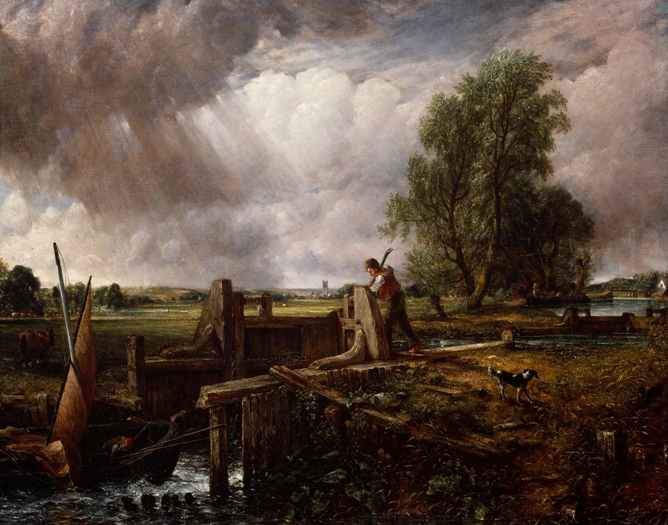 |
RA, London A Boat passing a Lock by John Constable, 1816 |
Constable 250th Anniversary
| By Roderick Conway Morris | Ipswich, SUFFOLK 8 June 2026 |
'In the coach yesterday coming from Suffolk, were two gentlemen and myself all strangers to each other. In passing the valley about Dedham, one of them remarked to me – on saying it was beautiful – 'Yes Sir – this is Constable's country!' '
The narrator was John Constable (1776–1837) writing to the engraver David Lucas (1802–1881) in November 1832, bearing witness that even within the artist's own lifetime this corner of the East Anglian countryside, immortalized by Constable's own paintings, was already bearing his name.
This year marks the 250th anniversary of his birth in the pastoral landscape – remarkably well preserved thanks to generations of admirers and more recently the National Trust and River Stour Trust – through which the waters of the Stour gently wind down to meet the River Orwell before reaching the North Sea. The occasion is being marked by a series of publications and exhibitions, presented under the general title of 'Constable 250'. Shows are being held at Christchurch Mansion in Ipswich, part of Colchester-Ipswich Museum, which has the largest collection of Constable's works outside London, and at Gainsborough's House in Sudbury.
Cometh the anniversary, cometh the book. In this case Susan Owens's 'Constable's Year: An Artist in Changing Seasons', published in January this year to universal and richly deserved praise. This compact, unfailingly insightful and beautifully written and illustrated volume acts as an ideal companion to the celebratory Suffolk exhibitions and will serve as an indispensable guide to the artist and his oeuvre for many years to come.
Contrasting his own works with those of his town-raised competitors on the eve of the RA Summer Exhibition in 1821, Constable wrote to his friend John Fisher (1748–1825): 'The Londoners with all their ingenuity as artists know nothing of the feeling of a country life (the essence of Landscape) – any more than a hackney coach horse knows of pasture.' As Owens observes, Constable was the only major landscape artist of his era who was a countryman born and bred. This lent him a unique understanding of nature and the seasonal cycles of rural life.
Unlike his forerunner and inspiration, Gainsborough, and his rival, Turner, Constable was born into a well-off family. This might have proved an advantage but in fact delayed his freedom to pursue his vocation as an artist. His father, Golding, having inherited money and property, had around 40 acres for growing grain, two mills, at Flatford and Dedham, a windmill on the heath to grind corn, barges to transport his flour on the Stour, and a brig to take it from the port of Mistley to market in London. He also owned a substantial house and grounds in East Bergholt near the ancient church.
In view of his older brother Golding's apparent fecklessness and possible epilepsy, John was the designated heir of the family concern and, after attending the grammar school in Dedham, was expected at the age of sixteen to devote himself to learning every stage of the business, from overseeing the workers on the land and at the windmill, the building and maintenance of the barges, and the shipment of the flour. This apprenticeship greatly delayed his efforts to become a professional artist – his near contemporary Turner was an RA by the time Constable was launching himself in London in 1802 – but was to bring to his works a profound knowledge and authenticity unrivalled among his contemporaries. And the activities he had mastered in the course of running his father's business would later inform and shape the subjects of his paintings.
Ever the practical man, Constable's father hoped that if his son insisted on becoming an artist he would devote himself to portraiture, which could guarantee a steady income. And indeed some of John's earliest paintings are portraits of friends and family, which feature in a charming and revealing exhibition 'Constable: A Cast of Characters', at Christchurch Mansion in Ipswich, curated by Emma Roodhouse, who is also the author of the accompanying book. The show focuses on his formative years and the local artists, collectors, antiquarians and connoisseurs in East Anglia who fostered his early career. Constable's revered Suffolk-born forerunner Gainsborough lived and worked in Ipswich in the 1750s and when Constable went out sketching in the countryside around the town in the summer of 1799 he wrote to a friend: 'I fancy I see Gainsborough in every hedge and hollow tree.'
In September 1812 John wrote to his wife-to-be, Maria, 'My father is always anxious to see me engaged in Portrait, and his ideas are most rational, but you know Landscape is my mistress – 'tis to her I look for fame.' Nonetheless, even after he had first exhibited his landscapes at the Royal Academy Summer Exhibition in 1802, as unsold canvases piled up in his studio he was forced to undertake portraits at low prices to eke out a meagre living. And when his fortunes improved, as the size of his family increased, he fell back on this reliable source of ready cash. A remarkable example of his later portraiture from a private collection is included in the 'Constable: A Cast of Characters' exhibition, depicting Emily Treslove (1783–1765), wife of a barrister, and a neighbour of the Constables in Charlotte Street in London.
It was painted in 1826, but Emily returned it three years later, apparently for some cosmetic surgery on her chin, and expressed herself well satisfied with the results. Aspects of this canvas seem almost to anticipate works by the likes of John Singer Sargent (1856–1925) and even Giovanni Boldini(1832–1941).
Constable was the least travelled of all the major landscape artists of the 19th century. While Turner had doggedly followed in the footsteps of his hero Richard Wilson through the wilds of Wales and roamed around the Continent at every opportunity, Constable was content to record an area of a few square miles in Suffolk. As he wrote to his wife Maria in 1812: 'You know that I have succeeded most with my native scenes. They have always charmed me & I hope they always will – I wish not to forget early impressions. As I have now very distinctly marked out a path for myself, and am desirous of pursuing it uninterruptedly.' And writing to his friend John Fisher in 1821, he enthused about 'the sound of water escaping from Mill dams…Willows, Old rotten Banks, slimy posts & brickwork. I love such things'.
Picturesque to urban dwellers though the Stour at Dedham Valley was, and remains, it was almost as much the product of pick, shovel and muck-bucket as of nature. The river here was a shallow stream but canalized to create a navigable channel, designed to meet canal standards in width and depth, following an Act of Parliament in 1705.
The original stream of the Stour is depicted meeting its new course in 'The Leaping Horse' (1825), although the artist has taken liberties with the topography, moving the distant tower of Dedham church to an entirely new position. The canalization of the Stour enabled the semi-industrialization of the valley, with the building of locks, dry docks and mills. Constable's paintings faithfully record the activities associated with this. Since not all the local landowners were equally co-operative with the Navigation Commission (of which Golding Constable père was a member from 1780 onwards), the towpath switched sides at certain points. This made it necessary to transport the barge horses across the flow, as illustrated in 'The White Horse' (1819). The animals also had to be trained to jump the three-foot-high barriers on the towpath installed to stop cattle straying (again, as depicted in 'The Leaping Horse').
Constable's later residences and peregrinations took in London, Brighton, Salisbury, Dorset, Kent and an uncharacteristically adventurous trip to the Lake District. Two primary factors obliged Constable thus to broaden his horizons (with, for the artist himself at least, unexpectedly beneficial results, on the breadth, variety and ambition of his ultimate oeuvre): his own need, for professional reasons, to spend extended periods in London and his wife's uncertain and declining health. As with other contemporary artists, the summer and autumn were spent in the field sketching, while the winter and spring were occupied with painting oils in the studio. Residence in London was essential while preparing for the all-important RA and other summer shows.
However, the deleterious effects on Maria of living in the city led Constable to take lodgings every year from 1819 onwards in the outlying area of Hampstead, for its more salubrious air and the rustic surrounds of the Heath, allowing him to 'see nature – & unite a town and country life'. The family was later to settle there in their own house at 6 Well Walk in 1827.
The artist had always taken a great interest in the weather, initially as a countryman for practical purposes, and was in the habit of noting times, dates and meteorological conditions on the backs of his sketches. But in Hampstead, where constant rural and industrial human and animal activity was lacking, he looked more and more to the heavens as a subject of art.
As he wrote, almost mystically, to John Fisher in 1821: 'The sky is the 'source of light' in nature – and governs every thing.' Two years later he became even more expansive, declaring to the same correspondent: 'I am the man of clouds.'
The further decline in Maria's health led in 1824 to her being advised to spend time in Brighton. Constable took an instant dislike to the place as a vulgar, gimcrack holiday resort but was grudgingly reconciled, writing to Fisher: 'In short there is nothing here for a painter but the breakers – & sky – which have been lovely indeed and varying.' He thus added seascapes to his repertoire of those pictures now regarded as among the greatest of his achievements.
The anniversary of Constable's birth is proving to be an opportunity to re-examine the relationships between three of the founding fathers of English landscape, and is the focus of 'Gainsborough, Turner & Constable: Inventing Landscape', curated by Emma Boyd, at the Gainsborough House in Sudbury. Particular attractions of this exhibition are Turner's watercolour Abergavenny Bridge, which has not been displayed publicly since the RA Summer Show in 1799, and Constable's 'The Leaping Horse' (1825), never before shown in Suffolk. The latter was one of the celebrated half-dozen 'six-footer' canvases he exhibited at the RA between 1819 and 1825. There is also a fascinating oil sketch, 'A Moorhen Startled from its Nest' (c.1825): it seems the artist's erstwhile sketching partner and studio assistant, John Dunthorne (1798–1832), sent a moorhen to him in London from Flatford, and Constable added this detail to the bottom right-hand of 'The Leaping Horse' canvas at the last minute.
Although the artist painted most of his large canvases in his London studio he executed a number of oils outdoors in Suffolk after 1814, notably 'Boatbuilding near Flatford Mill' (1815). This will feature with major loans from the RA, National Gallery, Tate, V&A and other collections in a forthcoming exhibition of some 70 pieces, 'The Hay Wain: Walking Constable's Landscape', at Christchurch Mansion in Ipswich. Entirely painted in London, 'The Hay Wain' too will be coming to Suffolk for the first time, along with several other of his canvases.
Curiously, when Constable embarked on 'The Hay Wain' at the end of 1820, he found that even among his compendious collection of sketches he could not find a suitable Suffolk model for the cart. And so he sent word to the ever-faithful Dunthorne to provide him with the 'outlines of a scrave or harvest waggon', which he duly did, despite the challenges of sketching outdoors in wintry weather.
Constable: A Cast of Characters, Christchurch Mansion, Ipswich, 28 March–14 June 2026
Gainsborough, Turner & Constable: Inventing Landscape, Gainsborough's House, Sudbury,
25 April–11 October 2026
The Hay Wain: Walking Constable's Landscape, Christchurch Mansion, Ipswich, 11 July–
4 October 2026
'Constable's Year: An Artist in Changing Seasons' by Susan Owens,Thames & Hudson, pp 223 £25
'Constable 250: A Cast of Characters' by Emma Roodhouse, Amberley Publishing, pp 96 £15.99
'Gainsborough, Turner & Constable: Inventing Landscape' by Emma Boyd (ed) Gainsborough's House pp 72 £7
A fully illustrated version of this article can be found at:
https://britishartjournal.co.uk/constable-250/
First published: British Art Journal: Online
© Roderick Conway Morris 1975-2026