 |
Gwen John: Strange Beauties
| By Roderick Conway Morris |
Cardiff, WALES 19 June 2026 |
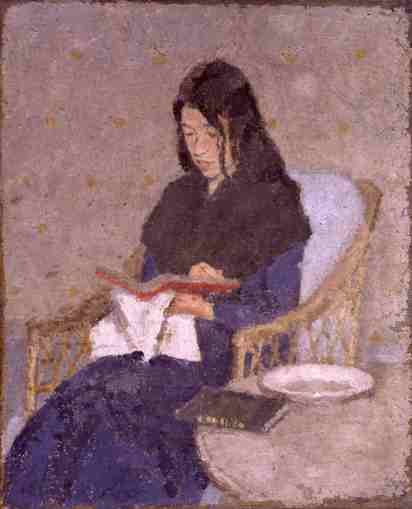 |
Ferens Art Gallery, Hull The Seated Woman (The Convalescent) by Gwen John c. 1920 |
'I cannot imagine why my vision will have some value in the world–yet I know it will,' wrote Gwen John (1876–1939) in 1910. John achieved a considerable degree of success during her lifetime. She won prizes as a student at the Slade School of Fine Arts in London and, when she exhibited a self-portrait in an exhibition there in 1902, her professor Frederick Brown snapped it up. It is now one of the most familiar images in Tate Britain. She gained recognition in France– where she spent most of her adult life–in Britain and the US. Her works were sought after throughout her career and she would have sold more but for her own reluctance to do so.
Her reputation, far from fading over time, has grown steadily in recent decades, outstripping her once more famous brother Augustus (1878–1961). This is now reflected in an engaging and outstandingly well-designed retrospective exhibition in her native land, marking the 150th anniversary of her birth, 'Gwen John: Strange Beauties', at Amgueddfa Cymru/National Museum Wales in Cardiff, curated by Rachel Stratton and Lucy Wood, who are also the editors of the attractive and thoroughly researched exhibition book. The show will travel on to Edinburgh, Yale and Washington DC. (This year is also the 100th anniversary of John's only solo exhibition during her lifetime, at the New Chenil Galleries in London.)
Amgueddfa Cymru bought its first work by John, 'Girl in a Blue Dress' in 1935, which was joined in due course by other pieces acquired by gift and purchase. In 1976, the centenary of her birth, the Museum acquired over 900 drawings, sketchbooks and oil studies from the artist's estate, making its holdings the largest public collection of Gwen John's work anywhere. This is the subject of a second publication, 'Unseen Gwen John', which focuses on the Museum's unique collection of works on paper, many never before displayed or published, and offers technical analysis of John's materials and working methods.
Gwen John was born into a middle-class family in West Wales in 1876, the second of four siblings, the last three of whom displayed artistic talents, both Gwen and Augustus becoming painters and Winifred (1879–1967) a violinist. Their father Edwin William John (1847–1938), a solicitor, moved the family permanently to Tenby after the death of the children's mother, Augusta, when Gwen was eight years old. Augusta had been an amateur artist, having studied in London.
Gwen's brother Augustus's precocious talents won him a place at the Slade School of Fine Art in London (founded in 1871) in 1894 at the age of sixteen. Gwen had to wait until the following year to join him there at the age of nineteen. The rigorous but progressive training she received under the likes of Professor Frederick Brown (1851–1941) and Henry Tonks (1862–1937), especially in the thoughtful and meticulous planning of every piece, stayed with her for the rest of her career.
After she graduated in 1898 Gwen went to Paris, where she attended the short-lived Académie Carmen founded by James McNeill Whistler (1834–1903) in Montparnasse. Although John's time with Whistler was relatively brief it had a considerable effect on her subsequent artistic development. He regularly took his students to see his 'Arrangement in 'Gray and Black No.1 (Whistler's Mother)' at the Musée Luxembourg, where John also clearly immersed herself in the famous bequest of Impressionist paintings left by Gustave Caillebotte (1848–1894). Monet's series paintings of the same subject may well have inspired her, or at least validated her existing preference, to tackle the same subject with variations over and again, which became a hallmark of her oeuvre.
During the first years of the 20th century John shuttled between London and Paris, studying, posing as a model and giving art lessons. She took up permanent residence in the French capital in 1904, living in various apartments in Montparnasse for the next seven years. At first, she principally made a living as a model and her brother Augustus suggested she approach the famous sculptor Auguste Rodin (1840–1917), by then in his early sixties, at his studio at Meudon on the outskirts of Paris. He already had some 90 models on his files but he took to her and she was soon sitting for him, frequently in nude poses, and he chose her as the model for a commission for a monument to Whistler. They became lovers and he encouraged her painting and drawing, but they never lived together. She wrote letters to him several times a week between 1904 and 1917. In 1911 she moved to Meudon, but continued to commute to her studio in the city.
The works of Paul Cézanne (1839–1906) held a special fascination for Gwen John. Thirty-six of his works were on display at the Salon d'Automne in Paris in 1904 and, in the autumn of 1907, there was a memorial exhibition devoted to him of 58 pieces. After Rainer Maria Rilke (1875–1926) became Rodin's secretary in 1906 she and the poet became friends. He shared her enthusiasm for Cézanne, attending the show at the Salon d'Automne almost daily to study them. John would later tell her American patron, John Quinn (1870–1924), that the experience of seeing Cézanne's 'The Painter's Father, Louis Auguste Cézanne (c.1865) 'made a step in the advance of my art'.
The wealthy American lawyer and collector John Quinn was already buying her brother's works when Augustus introduced his sister to him. Quinn became her sole patron, arranging to pay her an annuity of £100 a year and assuring her that he would purchase anything she produced, a commitment that continued until Quinn's death in 1924. It was through Quinn that her works appeared at the 1913 Armory exhibition in New York along with the modernist greats, from Manet, Gauguin, Monet and Renoir to Cézanne, Van Gogh, Seurat and Braque, and she began to make her name on the other side of the Atlantic. When the Albright Gallery of Art in Buffalo, New York, bought her Woman with a Cloak (c1920–24) from Quinn's estate in 1926, it was the first of her works to enter a US public collection. The picture is closely related to another, The Pilgrim, now in the Paul Mellon Collection at the Yale Center for British Art.
John's favourite subject-matter was evident early in her career, when she depicted almost entirely images of women, girls and children (although also including her cats), and flowers, especially in her drawings and watercolours, and her distinctive painting technique was established by the mid-1910s. In her oils she applied thick paint in quick brush strokes, which she called 'blobbing'. She also sometimes added glue and chalk to the paint to achieve more luminosity and texture and did not varnish her pictures to maintain their matt surface. Recent infrared analysis has shown that she sometimes made detailed preparatory under-drawings on the canvas but at others painted straight on to it.
She was happy to use a narrow range of models. Between the mid-1910s and mid-1920s she made over 60 paintings of a single woman, identified simply as a Meudon neighbour, often with only minor variations in the poses, position of the hands and accessories. Although some of her figure paintings include still-life elements, her atmospheric, pure still-lifes are regrettably rare.
Gwen and Augustus's father recalled how from a young age the siblings were in the habit of taking their sketchbooks with them on country and coastal walks in Pembrokeshire. On visits to the theatre they would record impressions of members of the audience during the intervals. John had already started to make sketches of church-goers when she attended services in Montparnasse. After she moved to Meudon, it became one of her most prolific artistic activities, and she produced thousands of drawings and watercolours of congregants, nuns, children and orphans – almost invariably from behind or in profile – despite the objections of the local curé.
By this time her affair with Rodin was faltering and, although it continued intermittently for another couple of years, it clearly resulted in a personal crisis. She regularly attended services at the Church of Saint Martin in Meudon, and began to take religious instruction from the local curé. By the beginning of 1913 she was fully received into the Catholic church. One consequence of this was that Gwen embarked on painting a remarkable series of portraits of nuns who ran an orphanage in their convent in Meudon. She even made, from a tiny prayer card, a series of full-scale posthumous portraits of the order's founder Mère Poussepin (1653–1744). One of these was bought by Quinn, from the nuns, with Gwen's approval, in 1920.
By the early 1920s John was styling herself 'God's little artist: a seer of strange beauties, a teller of harmonies, a diligent worker'. Although she gave some of her portraits titles suggestive of a religious element, notably 'The Pilgrim', she did not become a religious painter in a conventional sense. Nonetheless, many viewers now find a latent sense of spirituality in John's portraits of women and girls, which the development of her painting technique made increasingly powerful in her mature works. As one of John's most perceptive and sympathetic critics, Mary Chamot (1899–1993), wrote of 'The Pilgrim' when it was displayed in her only solo retrospective in 1926, the painting appears 'as through a haze, neither dull nor over-sunny but just radiant with a quiet luminosity'.
John maintained that her works on paper were 'quite as serious' as her oils and indeed consistently exhibited more of the former than the latter. Not long after her 1926 solo show John ceased to paint in oil, devoting the last years of her life to graphic art and watercolours. This may have been because, increasingly suffering from ill health, she no longer felt strong enough to expend the immense effort required to create her richly layered paintings.
In 1939 she went to Dieppe, possibly hoping that the sea air would restore her energies. But she died shortly afterwards and was buried in a municipal cemetery. Fortunately, she had time to make her will while in hospital there. Her nephew and heir, the watercolourist Edwin John (1905–1978), managed to get to Paris before the Nazi invasion to recover stacks of paintings and 'a mass of beautiful drawings', which might otherwise have been dispersed or lost. These he shipped across the Channel and many of them now form part of Amgueddfa Cymru's impressive Gwen John collection.
Gwen John: Strange Beauties, Amgueddfa Cymru/Museum Wales, Cardiff, 7 February–28 June 2026
National Galleries Scotland: Modern Two, Edinburgh, 1 August 2026–4 January 2027
Yale Center for British Art, Connecticut, 18 February–20 June 2027
National Museum of Women in the Arts, Washington DC, 30 July–28 November 2027
'Gwen John: Strange Beauties' by Rachel Stratton and Lucy Wood, Yale Centre for British Art with Museum Wales, pp 272 £50
'Unseen Gwen John' by Helen Anderson, Rachel Beard, Fiona McLees and Lucy Wood, National Museum of Wales, pp 128 £24.99
A fully illustrated version of this article can be found at:
https://britishartjournal.co.uk/gwen-john-in-wales/
First published: British Art Journal: Online
© Roderick Conway Morris 1975-2026