 |
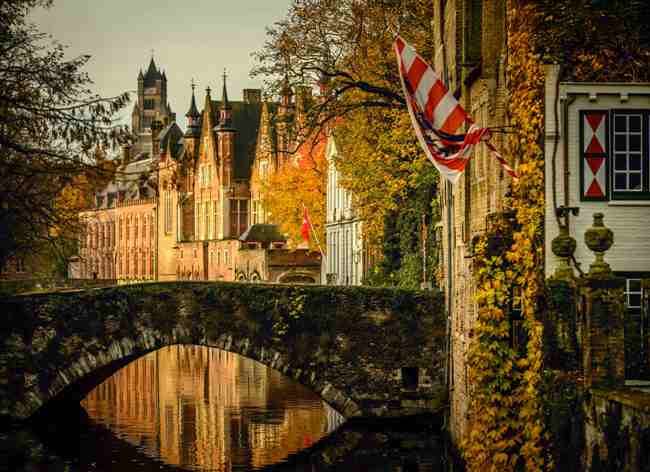 |
Jan Dartet/Visit Bruges The Gronerei Canal in Bruges |
Connected Worlds of Bruges
| By Roderick Conway Morris | BRUGES 31 July 2026 |
'The city of Bruges is a large and very wealthy city, and one of the greatest markets of the world,' wrote the 15th-century Spanish traveller Pero Tafur (c1410–c1484). 'It is said that two cities compete with each other for commercial supremacy, Bruges in Flanders in the West and Venice in the East. It seems to me, however, and many agree with my opinion, that there is much more commercial activity in Bruges than in Venice'.
By the time Tafur reached Bruges his long peregrinations, which lasted between 1435 and 1439, were coming to an end, before he returned to his birthplace in Cordova. His travels had taken him all over the Mediterranean. He had spent time in Alexandria, Cairo, Jerusalem and Constantinople, ventured as far as Trebizond, and journeyed the length and breadth of Italy. When making such a comparison he was therefore casting an expert eye. Indeed, his account of Bruges and Flanders is uniquely detailed as an eye-witness report from period. Tafur paints a vivid picture of the plethora of goods available in the marts of Bruges:
'I saw oranges and lemons from Castile, which seemed only just to have been gathered from the trees, fruits and wines from Greece, as abundant as in that country. I saw also confections and spices from Alexandria, and all the Levant, just as if one were there; furs from the Black Sea, as if they had been produced in the district. Here was all Italy with its brocades, silks, and armour and no part of the world whose products are not found here at their best.'
How Bruges rose to this position as the most important commercial, cultural and artistic centre in Northern Europe between the 13th and 15th centuries is the subject of 'Bigger Picture: Connected Worlds of Bruges 900–1550', an absorbing exhibition staged to mark the opening of BRUSK (Brugge Schone Kunsten), the city's brand-new exhibition venue which opened this spring – right in the historic centre next to the Groeningemuseum. The show is curated by Peter Frankopan and Jan Dumolyn, who are also the editors of the accompanying attractively designed and richly illustrated volume of the same title, containing the contributions of over a dozen international scholars on the development, economy, trading networks, religious, cultural and social life of the city.
Whilst all of these essays are enlightening in their different ways and the book will take a worthy place on the shelves of any lover of this enchanting survival of the Middle Ages, Frankopan's hopes that it will 'stand as a work of scholarship in its own right' is undermined by the fact that there are few notes, limited information on the artworks featured and it lacks both a bibliography and index.
Bruges was both the beneficiary and the victim of its geographical position. It stands on the River Rei now some 12 km from Zeebrugge. Its foundation dated back to the 9th century when Count Baldwin Iron-Arm (r 862–79) established a fortress there, which became a refuge against the Viking attacks. A violent storm and tidal surge in 1134 created the Zwin estuary, which overnight gave the town direct trading access to northern seas and stimulated the construction of harbour facilities. Silting (a recurrent challenge) of the Zwin led to the establishment of the outer harbour of Damme about 5 km north of Bruges in 1180. A fair was established in 1200, which attracted merchants from a wider area. In the late 13th century, the additional port of Sluys was built on the Zwin. The first galley from Genoa via the Strait of Gibraltar arrived in 1277 and from Venice in 1314. In 1294 the English King Edward I granted Bruges the wool staple, meaning that all English wool sold in continental Europe had to pass through the city. While other cities in Flanders, notably Ghent and Ypres, manufactured larger quantities of textiles, Bruges dominated in their export. By 1380, twenty-three types of woollen weaves were being offered in the town's Cloth Hall.
Unlike Venice, Bruges was fated always to bear the yoke of princely rulers: the Counts of Flanders until 1384, the Dukes of Burgundy until 1477, and thereafter the Hapsburgs. Not infrequently the burghers of Bruges rose against their masters and their agents and even established their independence for short periods, but these outbursts were inevitably finally crushed, leading to bloody reprisals and the execution and exile of the rebels. This aspect of the city's history is largely passed over by the current exhibition and book.
Robert I Count of Flanders (c.1035–1093) undertook the pilgrimage to Jerusalem and the Holy Land in 1086. During his journey he met the Emperor Alexis I Komnenos in Constantinople. Robert's descendants became dedicated Crusaders. These adventures took a dramatic turn when Count Baldwin IX (1172–1205) participated in the Fourth Crusade, which led to the Sack of Constantinople at the hands these Christian warriors in 1204. Baldwin was elected the Latin Emperor of Constantinople, putting this rather minor northern European fiefdom firmly on the map. His court at Byzantium was almost entirely composed of his compatriots, right down to his chef and baker.
Baldwin's brother Henry of Flanders (c.1178–1216) was crowned his successor in 1206 and the Flanders dynasty went on to rule Constantinople and other regions of the Latin Empire in the East until 1261. These Flemish Latin Emperors remained firmly attached to their homeland, consistently including the word 'Flandras' in their seals. And the links forged with Constantinople and the Holy Land created a kind of special relationship between this part of the Low Countries and the Levant. The backdrop depicted in 'The Crucifixion' by Jan Provost was very likely the result of his own observations on the spot.
No major city in Christendom worth its salt could hold its head high without being in possession of important holy relics or even an entire saint. To this end Venice had spirited the remains of St Mark out of Alexandria in 828 and Bari hijacked those of St Nicholas from Myra in Asia Minor in 1087. As early as 1058 an itinerant monk from the abbey of St Winnoc in Flanders had stolen the relics of St Lewinna from the church at Bishopstone near Seaford in Sussex. But the long-term political and commercial presence of the Flemish in the East opened up vastly greater opportunities, through appropriation and negotiation, for the acquisition of prestigious relics, especially from Constantinople, the greatest single source of them.
By the late 13th century Bruges had secured a phial of the Holy Blood of Christ, kept at St Basil's chapel by the City Hall. This became the focus of an annual procession in May, still held with great pomp even to this day. As Andrew Brown relates in his excellent essay in the catalogue, 'Approaching the Divine in Late Medieval Bruges', St Donation's Church claimed to have not only the body of its titular saint but the relics of 92 others. Such treasures became the occasion for multiple feast days, rituals, processions, bell-ringing, and so on, that attracted pilgrims from far and wide and helped further to fill the coffers of this increasingly wealthy commercial hub.
The flowering of the 'new art' initiated by Jan van Eyck also enabled Bruges burghers to display their religiosity publicly by having themselves vividly portrayed along with the Holy Family and saints. As Bruges prospered it became the home of a large number of foreign merchants and bankers. Some of them not only took up long-term residence in the city but also married into the local elite. The outstanding monument to this practice is the Adornes Domain. The family was originally from Genoa but in the 15th century Anselm Adornes (1424–1483) married Margareta van der Banck (1427–1480). On their return to Bruges from the Holy Land, Pieter II and Jacop Adornes had built in the 1420s and 1430s the Jerusalem Chapel based on the Holy Sepulchre as part of their residential complex. Anselm and Margaret were laid to rest there in the centre of the nave in a tomb with their effigies. They were further memorialized in the chapel in the mid 16th century in one of a series of fine stained-glass windows.
Bruges experienced the height of its artistic splendour following its absorption into the realms of the House of Burgundy from 1384. Art for these dukes was, to an extent seldom seen before or since, primarily a means of projecting the magnificence of their dynasty, and they were prepared to spend prodigious sums to this end. No better illustration of this could be found than an astonishing reliquary on loan here from the Treasury of the Cathedral at Liège by Charles Loyet (fl 1466–1502–3) of a kneeling Charles the Bold (1433–1477) holding the reliquary of St Lambert supported by St George, which is both a breathtaking sculpture and overpowering demonstration of opulence.
It was under Burgundian rule that Bruges became the epicentre of the revolution in painting led by Jan van Eyck (c.1390–1441), Hans Memling (c.1430–1494), Gerard David (c.1460–1523), and their followers. Curiously, none of these celebrated artists were natives of the city but were attracted thither by the rich possibilities offered by the lavish patronage and refined tastes of the Dukes and the town's competitive burghers.
A figure highlighted by the exhibition and catalogue is Lodewijk van Gruuthuse, also known as Louis of Bruges (1422–1492). This cultivated diplomat, soldier, accomplished jouster and scholar served under Dukes Philip the Good and Charles the Bold. He amassed an impressive art collection and a library that rivalled the famous Burgundian ducal library. He worked closely with Caxton (whose first book in English was printed in Bruges) and was responsible for introducing Flemish manuscript illumination into England, having hosted Edward IV when he fled during the Wars of the Roses in the early 1470s. Lodewijk's former palace is now the fascinating Bruges Gruuthusemuseum, devoted to the city's history.
Two factors led in the late 15th century to the demise of Bruges as the cosmopolitan commercial, religious and cultural capital of Flanders. The first was the long-standing problem of the silting of her access to the North Sea. In the words of Ernest Gilliat-Smith's elegiac last chapter in his indispensable 'The Story of Bruges' (1921): 'As early as 1410 the navigation of the Zwin, even as far as Sluys, had become exceedingly difficult; by the close of the century no great vessel could reach Damme, and before another fifty years had elapsed Bruges was cut off altogether from the sea.'
The second was political. The failure of Charles the Bold to produce a male heir resulted in his daughter Marie of Burgundy inheriting the Duchy after his death at the Battle of Nancy in 1477. Two years later she married a Habsburg, Maximilian I of Austria, the son of the Holy Roman Emperor Frederick III, but she remained the guardian and regent of her son Philip the Handsome (1478–1506). After the untimely death of Marie in a riding accident in 1493, in the face of an uprising and the heroic resistance of the burghers – who at one point incarcerated Maximilian in the Gruuthuse Palace – and citizens of Bruges, Maximilian regained control of the city.
Maximilian executed the leaders of the resistance. Lodewijk van Gruuthuse, who had participated in the rebellion was also indicted. As a Knight of the Golden Fleece and a peer of Flanders, France and England, he would have been entitled to be tried by his equals. But in a telling demonstration of his profound patriotic loyalties, he declared that as a burgher of Bruges he preferred to be judged by the burgher magistrates of his own town. In the end, Lodewijk's popularity restrained Maximilian from going further than imprisoning him in Mechelen and imposing a large fine.
These events, both geographical and dynastic, ushered in the end of Bruges's most glorious years. Foreign merchants, with the encouragement of a vengeful Maximilian, deserted Bruges for Antwerp and, during the 16th and 17th centuries, that city on the Scheldt became, as later did Amsterdam, the principal international mart and artistic centre of the Low Countries.
Bigger Picture: Connected Worlds of Bruges 900–1550, BRUSK, Bruges, 8 May–6 September 2026
'Connected Worlds of Bruges 900–1550' by Peter Frankopan and Jan Dumolyn, eds, Hannibal Books, pp304 €59
A fully illustrated version of this article can be found at: :
britishartjournal.co.uk/brusk-a-new-exhibition-venue-in-bruges/
First published: British Art Journal: Online
© Roderick Conway Morris 1975-2026