 |
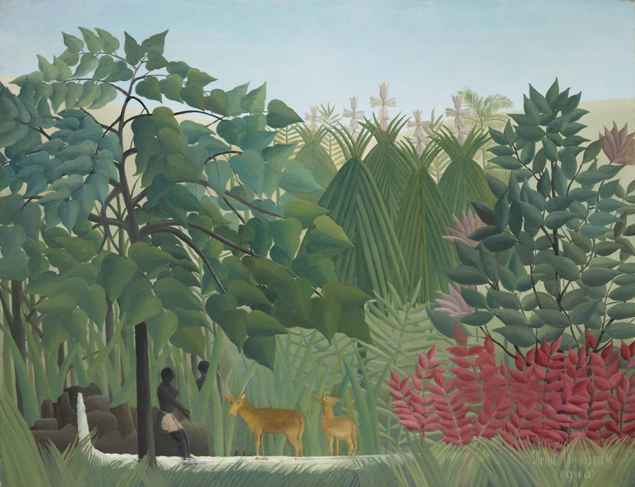 |
Art Institute of Chicago The Waterfall by Henri Rousseau, 1910 |
The Ambition of a Painter
| By Roderick Conway Morris | PARIS 29 July 2026 |
'Born in Laval in 1844, he was soon obliged by his family's limited means to pursue a career other than the one to which his artistic inclinations led him,' Henri Rousseau (1844–1910) wrote in 1895, when invited to provide a short autobiographical entry for a biographical dictionary of artists and writers that never saw the light of day.
His early experience of work after finishing at the local lycée in the town of his birth on the Loire, a couple of hundred miles south-west of Paris, was not auspicious. He was caught stealing from his employer and joined the French Army in the hope of a lighter sentence. He appeared in uniform at his trial and served only a month in prison. He moved to Paris in 1868 and three years later found steady work as a collector of dues at one of the city's tollgates – which would later lead the poet Alfred Jarry (1873–1907) to call him the 'Douanier', a misnomer, since he was never a customs officer.
Idle periods during his long shifts as toll collector allowed him to spend time painting. He was entirely self-taught or, as he put it in his only interview, with Arsène Alexandre, for the newspaper 'Comœdia' (19 March 1910) some six months before his death in September of that year, he was 'élève de moi-même' (my own pupil), a wording that was echoed in the title of his self-portrait 'Moi-même, portrait-paysage' ('Myself, Portrait-Landscape') (1890).
He depicts himself with the artistic props of palette, brushes, beret and bushy beard, a declaration of intent, since it was made three years before he retired from his job at the tollgate. It also reflects his determination to become a traditional realist artist faithfully capturing the contemporary world in which he lived. He includes a modern iron bridge, a hot-air balloon and the Eiffel Tower, at that time envisaged as a temporary structure erected the year before for the Esposition universelle. The names on the palette are of his first and second wives, Clémence and Joséphine.
This self-portrait opens the present exhibition at the Musée de l'Orangerie, Paris, which has travelled on from the Barnes Foundation in Philadelphia. The show spans the entire career of this remarkable maverick artist and brings together for the first time a substantial part of the two largest single collections of the painter's works – those of these two institutions. It has been made possible by the change in the rules of the Barnes Foundation in 2023, allowing the loan of nine of its 18 Rousseau paintings, including 'Unpleasant Surprise' (1899–1901), 'Scouts Attacked by a Tiger' (1904) and 'Woman Walking in an Exotic Forest' (around 1910). They are joined by other major works from the Beyeler Foundation in Basle, the Art Institute of Chicago, the Cleveland Museum of Art, the National Museum of Art and the Phillips Collection in Washington, and others, and by what is now perhaps Rousseau's most famous image, 'The Sleeping Gypsy' (1897) from MoMA in New York.
In 1884 the artist obtained a permit to be a copyist in the Louvre. It appears this was thanks to the intervention of the Orientalist painter
Félix-Auguste Clément (1826–1888), winner of the Prix de Rome in 1856. He was also treated sympathetically by another academician, the historical and orientalist painter and sculptor Jean-Léon Gérôme (1824–1904). Rousseau nurtured a life-long ambition to be accepted as a mainstream academic painter, however deluded this might have appeared to any dispassionate observer, given his lack of training and basic skills. He claimed in his only interview that he was barred from the École des Beaux-Arts on account of his age. He also asserted: 'If I have maintained my naïveté, it is because M. Gérôme and M. Clément always told me to do so.'
When Rousseau did finally retire in 1893 at the age of 49 to devote himself to painting, his modest pension meant that he still had to make a living, which he hoped to do by selling his pictures. He took up residence in Montparnasse, an inexpensive district popular with aspiring artists and writers, artisans and petit-bourgeois families. Living from hand-to-mouth he also offered drawing and music lessons.
He essayed multiple genres: portraits, also of children and families, paintings of weddings and christenings, landscapes and townscapes, views of the Seine, of factories and still-lifes, sometimes on commission but often on spec, in the hope of finding a buyer. If a picture failed to sell he would sometimes paint a new image over it. He entered three public competitions for the decoration of town halls – in Bagnolet, Vincennes and Asnières in the suburbs of Paris – without success.
When these proposals were rejected he sold his entries simply as landscapes. After the artist's death Robert Delaunay (1885–1941) picked up two of them from a bouquiniste on the banks of the Seine (Pl 3). In 1908 Picasso (1881–1973) acquired from a junk shop for 5 francs Rousseau's 'Portrait of Yadwiga' (a Polish woman the artist had once been smitten with) and later declared it 'one of the most truthful of French psychological portraits'.
In 1886, with the encouragement of one its founders, Paul Signac (1863–1935), Rousseau exhibited his first four canvases at the Salon des Indépendants, where he was to show almost every year until his death. One of them was his 'An Evening of Carnival' (1886), which may well have been a tribute to Gérôme's 'Suites d'un Bal Masqué' that had caused a sensation at the Salon of 1857. Rousseau's enigmatic image was one of his first nocturnal, almost dream-like scenes that anticipated, and inspired, later Surrealist paintings. It did not find a buyer, however, and was one of the canvases he used to settle bills with the likes of his cleaning lady, doctor, laundress and the baker.
At the Salon des Indépendants in 1891, he exhibited 'Surprise!' (National Gallery, London), a startling image of a ferocious tiger bearing its teeth as it stalks through a thunderstorm-lashed tropical rain forest, the first of his large canvases with jungle and exotic locations, on which his international fame would ultimately rest. It was rumoured that such scenes were inspired by his time in the army in Mexico, although he later admitted that he had never set foot outside France.
In reality, his sources for these splendid canvases were the Jardin des Plantes, the stuffed animals at the Natural History Museum, illustrations in magazines and a children's book, 'Bêtes Sauvages', published by Galeries Lafayette (Pl 6). As the artist said in his interview with Arsène Alexandre of his visits to the hothouses of the Jardin des Plantes: 'When I go through those doors and I see those strange plants from exotic countries, I seem to be in a dream! I feel myself another person.'
In these paintings he abandoned his realist ambitions and displayed a rich imagination in conjuring up vibrantly colourful scenarios, sometimes mysterious, at others menacing and others still teetering on the edge of the comic. 'I always see a picture before I paint it – even if it is very complicated,' as he told Alexandre. He also demonstrated with his unconventional but sumptuous colour palette a genius for painting foliage and trees, with striking contrasts and subtle gradations, both with a broad brush and in minute detail.
Although while he lived Rousseau was ignored by the public and routinely ridiculed by the critics, appreciation of his works began to grow in avant-garde artistic circles. Félix Vallotton (1865–1925) went so far as to hail the artist's 'Surprise!' as 'the alpha and omega of painting'. In 1906 he met Robert and Sonia Delaunay (1885–1979), Guillaume Apollinaire (1880–1918), and the art dealer and critic Wilhelm Uhde (1874–1947) and began to hold musical and literary soirées at his studio in Montparnasse.
Rousseau's relations with his avant-garde contemporaries was the subject of a memorable exhibition at the Doge's Palace in Venice, then at the Musée d'Orsay in Paris (2015–16). It was reviewed by this writer in the International New York Times ('Rousseau's Wide Circle of Devotees', 29 July 2015: https://www.roderickconwaymorris.com/Articles/641.html).
Indeed, it was these avant-garde admirers and a new generation of dealers in modern art in Paris and collectors in the US that stimulated a spectacular rise in the value of Rousseau's works after his death, a subject expertly explored by Juliette Degennes in her essay 'Rousseau parmi les modernes: un cas singulier sur le marché de l'art', in the exhibition's catalogue.
In 1911 Wilhelm Uhde wrote the first monograph on the artist and Robert Delaunay organized a posthumous retrospective at the Salon des Indépendants of 47 paintings and drawings. In the first public sale of Rousseau's paintings in 1914, 'Scouts Attacked by a Tiger' fetched 7,500 francs. The American lawyer and collector John Quinn (1870–1924) bought 'The Sleeping Gypsy' in 1923 for 175,000 francs. When his collection was auctioned in Paris in 1926, it went for 520,000 francs. At a sale at Christie's New York in May 2023 one of the artist's exotic monumental canvases, 'Les Flamants' (1910), went for $37,500,000 putting this untutored modern master on a par with the likes of Renoir, Picasso and Matisse.
Henri Rousseau, l'ambition de la peinture
The Barnes Foundation, Philadelphia, 19 October 2025–22 February 2026
Musée de l'Orangerie, Paris, 25 March–20 July 2026
'Henri Rousseau: L'Ambition de la Peinture', by Juliette Degennes (editor), Musée de l'Orangerie/Flammarion, 226 pp, €39, ISBN 9782080511812
A fully illustrated version of this article can be found at:
https://britishartjournal.co.uk/henri-rousseau-lambition-de-la-peinture/
First published: Bristish Art Journal: Online
© Roderick Conway Morris 1975-2026